Two Kings and Nobody in Charge
On 11 June 323 BC Alexander the Great died in Babylon, 32 years old, with no heir of age. His officers made two kings, his half-brother Arrhidaeus as Philip III and the child Roxane was carrying, a boy who became Alexander IV, and then fought over the empire for 42 years. The last of them, Seleucus, was stabbed from behind near Lysimacheia in 281 BC by a son of Ptolemy. By then both kings had been murdered, and so had Alexander's mother, his sister and his other son.
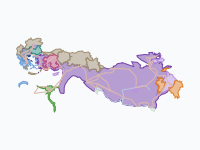
The Alexander map ends where this one begins. Each dynast keeps one colour throughout, so you can watch Antigonus' rose spread from Phrygia to Iran and shrink to a few ports in one battle, and Seleucus' gold come back to Babylon with about a thousand men and grow until it reaches the Aegean.
323–320 BC: The Regent, the Greeks and the Stolen Body
At Babylon Perdiccas became regent and the provinces were shared out: Ptolemy took Egypt, Lysimachus Thrace, Antigonus Phrygia, and Eumenes got Cappadocia, which Perdiccas had to conquer for him in 322. Antipater stayed in Macedon. Greece rose at once (the red of revolt on the map): Athens hired 8,000 mercenaries with the money Harpalus had left behind, and the Greeks shut Antipater up in Lamia for the winter. Once Craterus had brought Alexander's veterans over from Asia they lost at Crannon in late summer 322 (Diodorus has more than 40,000 Macedonian heavy foot against 25,000 Greek foot). Athens took a garrison and Demosthenes took poison.
Then Ptolemy took the body. In late 321 the golden funeral carriage, drawn by 64 mules, left Babylon, and Ptolemy met it in Syria with an army and buried Alexander at Memphis (the dark red disc is the cart). Perdiccas marched on Egypt with the kings and tried to wade his army to an island opposite Memphis: Diodorus says more than 2,000 men were lost, about 1,000 of them to crocodiles. That night a group of cavalry officers, Seleucus among them, stabbed him in his tent, two days before the news came that Eumenes had beaten and killed Craterus. Later that summer, at Triparadisus in Syria, Antipater became regent, gave Babylonia to Seleucus, handed Antigonus the royal army and the war against Eumenes, and took both kings home to Macedon.
319–316 BC: Eumenes and the Silver Shields
Eumenes (sky blue) lost to Antigonus at Orcynia in 319 and held out in the rock fort of Nora with 600 men. When Antipater died that autumn he passed over his son Cassander for the old officer Polyperchon, who made Eumenes general of Asia, with the royal treasure and the 3,000 Silver Shields, Alexander's veteran guards. He marched east, joined the satraps of the upper provinces and fought Antigonus twice in Iran. At Paraitakene in autumn 317 Diodorus gives Antigonus more than 28,000 foot, 8,500 horse and 65 elephants against Eumenes' 35,000 foot, 6,100 horse and 114 elephants, and the battle was drawn. At Gabiene in the winter of 317/6 Antigonus' horse rode round in the dust of a salt plain and took Eumenes' baggage camp. The Silver Shields had beaten the enemy phalanx without losing a man, but the camp held their wives, children and thirty years of loot, and they traded Eumenes for it. He was put to death. These figures come from Hieronymus of Cardia, who fought on Eumenes' side, and modern historians take them as they stand.
In Macedon, Olympias came home with Polyperchon in autumn 317. The army would not fight Alexander's mother, and she had Philip III stabbed (in October or December 317; the sources disagree) and sent his wife Eurydice a sword, a noose and hemlock. Cassander starved her out of Pydna, and after she surrendered in spring 316 she was killed. He locked the boy king and Roxane in the citadel of Amphipolis. Antigonus, meanwhile, executed Peithon and took 15,000 talents from Susa, and his rose now covered Asia from the Aegean to Iran.
316–309 BC: Gaza, Seleucus' Ride and the End of Alexander's Line
In summer 316 Antigonus asked Seleucus for the accounts of Babylonia, and Seleucus rode for Egypt with fifty horsemen. The others joined against Antigonus, and the war turned at Gaza in late 312 (some historians argue for spring), where Ptolemy and Seleucus, with 18,000 foot and 4,000 horse, beat Antigonus' son Demetrius, 22 years old, with about 11,000 phalanx men, 4,400 horse and 43 elephants, which were stopped by a line of iron spikes and all captured. With 800 foot and about 200 horse from Ptolemy (Appian has 1,000 and 300), Seleucus rode back and stormed the citadel of Babylon in April or May 311, the year from which his successors counted their era, and that summer he beat by night an army that Diodorus puts at more than 10,000 foot and about 7,000 horse.
In the winter of 311/0 the others made the Peace of the Dynasts and left Seleucus out: each kept what he held, and Cassander was to be general of Europe until Alexander IV came of age. In 310 (or 309) Cassander had the boy, now about 13, and Roxane killed and the bodies hidden, though Babylonian scribes went on dating by him until 306/5. Heracles, Alexander's son by Barsine, was killed in 309, and his sister Cleopatra at Sardis in 308, on her way to marry Ptolemy. Antigonus fought Seleucus round Babylon for a year and gave up the east for good in August 309.
306–301 BC: Kings, Rhodes, Indian Elephants and Ipsus
With Alexander's house gone, the fiction of ruling for the kings ended. In 306 Demetrius destroyed Ptolemy's fleet off Salamis in Cyprus (Diodorus gives him 108 warships in the line, Plutarch 180), and Antigonus put on the diadem and made his son king too. Within two years Ptolemy, Seleucus, Lysimachus and Cassander had done the same. In 305 Demetrius besieged Rhodes, which would not join Antigonus against Ptolemy, with 200 warships, nearly 40,000 soldiers and a nine-storey siege tower that took 3,400 men to move. The city held out for a year and later paid for the Colossus by selling the siege train he left behind.
Seleucus spent these years in the east, on a march with no recorded stage (his route on the map is a reconstruction). Appian says only that he crossed the Indus and fought Chandragupta until they came to an understanding and made a marriage alliance; no ancient writer names a winner. Strabo gives the terms: the lands along the Indus for 500 elephants. Tarn doubted the figure, but most now accept about that number, and Diodorus has 480 elephants with Seleucus in Cappadocia in the winter of 302. What was ceded is disputed. The Parapamisadae and Gandhara are certain, Arachosia probable and eastern Gedrosia likely, and the map turns those four orange. Aria rests only on a vague line of Pliny, so it stays gold.
In 301 Seleucus and Lysimachus met Antigonus and Demetrius at Ipsus. Plutarch gives Antigonus more than 70,000 foot, 10,000 horse and 75 elephants, and the allies 64,000 foot, 10,500 horse, 400 elephants and 120 chariots; modern writers accept his totals in the main but often raise the allied horse to about 15,000. Demetrius chased the allied cavalry too far and Seleucus' elephants blocked his way back. Antigonus, past eighty, died under the javelins; Demetrius got away with 5,000 foot and 4,000 horse. The winners carved up the realm: Lysimachus took Asia Minor to the Taurus, Seleucus Syria, Cassander's brother Cilicia, and Cassander kept Greece. Ptolemy, who had not fought, kept southern Syria anyway, the root of six Syrian Wars.
301–281 BC: Demetrius, Pyrrhus and the Last Two Generals
Demetrius still had the fleet, Cyprus, Tyre, Sidon and Corinth. After Cassander died in 297 (or 298) one of his sons killed their mother, and the other called in Pyrrhus of Epirus (olive), back from exile with Ptolemy's money, who took a slice of western Macedon as his fee. Demetrius came too, and at Larissa in autumn 294 his guards killed the young king at dinner and the army hailed Demetrius king of Macedon. In 288 (or 287) Lysimachus invaded from the east and Pyrrhus from the west, Demetrius' army went over to Pyrrhus at Beroea, and the two shared Macedon (no line between the halves is recorded; the map's border on the Axios is a modern guess). His last march across Asia Minor cost him at least 8,000 men to hunger and disease, and early in 285 he gave himself up to Seleucus in the Amanus hills. He drank himself to death in captivity in 283 (or 282).
That left Lysimachus at his height, ruling Thrace, Macedon, Thessaly and Asia Minor to the Taurus by 284. Then, urged on by his wife Arsinoe, he had his heir Agathocles killed (283 or 282), and his officers and cities turned to Seleucus. Ptolemy I died in the winter of 283/2 at about 84, the only one of the Successors to die in his bed. Early in 281 the last two of Alexander's officers met at Corupedium, west of Sardis; no ancient writer gives the size of either army. Lysimachus, in his seventies, was killed by a javelin.
Seleucus now held Asia from the Aegean to Bactria. He crossed the Hellespont to take Macedon, and near Lysimacheia, as he looked at an old altar, Ptolemy Keraunos, Ptolemy I's passed-over elder son, stabbed him from behind and had the army hail him king. The Babylonian king list puts the death in the month from 26 August to 24 September 281. In the last frame Macedon turns Keraunos' rust, and Seleucus' son Antiochus I inherits the gold.
How to Read the Map
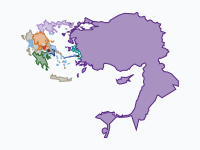
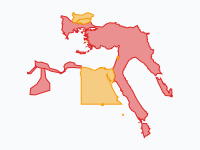
Each dynast keeps one colour: purple for land held for the kings (and for Polyperchon's regency), blue for Antipater and a darker blue for Cassander, rose for Antigonus and Demetrius, green for Ptolemy, gold for Seleucus, teal for Lysimachus, sky blue for Eumenes, maroon for Peithon in Media, dark cyan for Peucestas' league of the upper satraps, olive for Epirus, rust for Keraunos and orange for the Indian kingdoms and the Maurya Empire. Red is revolt. The paler tones are land no dynast held: grey for free Greek states such as the Aetolians, Sparta and Rhodes, stone for kingdoms nobody held (Cappadocia, Bithynia, Pontus, Armenia and others), lilac for client kings and pale blue for the League of Corinth.
The discs are the generals and their armies in their master's colour, sliding from one recorded stop to the next; each leaves the map with a pin when its person dies. Ship shapes are fleets, the two small purple discs are the kings and the dark red one is Alexander's body. Pins mark battles and sieges (dark red), sea battles (blue), deaths (black), new cities (green) and political events (dark brown); smaller, paler pins are lesser events, and the battle pins carry the ancient figures with their author.
Most of the 98 frames show only a year, and that is on purpose. Only three days are firm: Alexander's death, Seleucus entering Babylon on 14 November 320 and the sack of Cuthah. The rest is known to the month, the season or only the year, so the timeline shows the year and the caption the rest ("Autumn 317 BC"). Ipsus has no surviving day or month at all.
How the Map Was Made
The story follows Diodorus, Plutarch, Arrian, Justin, Appian and the Babylonian chronicles (via Livius.org). The borders are about 150 pieces, modern Natural Earth provinces cut along researched lines, each with its own timeline of owners; many changes, such as the split of Macedon in 288–285, are dated by no source. The coasts are modern except at the head of the Persian Gulf and in the Indus delta.
The years before 311 can be counted two ways, and about forty events move by a year between them. The high chronology puts Triparadisus in 321 and Gabiene in the winter of 317/6, the low one in 320 and 316/5. The mixed scheme of Boiy and Meeus takes the low date for 320 and the high dates for 317–316, because the Babylonian chronicle puts the war with the satrap of Egypt in Philip's fourth year and has Antigonus in Babylonia in summer 316. The map follows it, with Triparadisus in 320 as on the Alexander map, and the pins give the other dating.
Chronological Timeline
- 11 June 323 BC: Alexander dies in Babylon; two kings and a regent
- 323–322 BC: the Lamian War, ended at Crannon
- Late 321 BC: Ptolemy takes Alexander's body to Egypt
- 320 BC: Perdiccas murdered on the Nile; Triparadisus
- Autumn 317 BC: Olympias has Philip III killed; Paraitakene
- Winter 317/6 BC: Gabiene; Eumenes handed over
- Late 312 BC: battle of Gaza
- 311 BC: Seleucus retakes Babylon; Peace of the Dynasts
- 310 BC (or 309): Alexander IV murdered
- 306 BC: Salamis; Antigonus and Demetrius take the title of king
- About 303 BC: Seleucus cedes the Indus lands for 500 elephants
- 301 BC: Ipsus; Antigonus killed
- Autumn 294 BC: Demetrius king of Macedon
- 288 BC (or 287): Demetrius driven out
- Early 281 BC: Corupedium; Lysimachus killed
- August–September 281 BC: Seleucus murdered near Lysimacheia
Watch Alexander's empire come apart, from his death in Babylon to the murder of Seleucus, and follow the generals and their armies from Greece to the Indus.
Open the animated map →Frequently asked questions
- Who were the Diadochi?
- The Diadochi, or Successors, were the generals of Alexander the Great who fought over his empire after he died in Babylon on 11 June 323 BC: Perdiccas, Antipater, Craterus, Eumenes, Antigonus One-Eye and his son Demetrius, Cassander, Ptolemy, Lysimachus and Seleucus. They ruled at first in the name of two kings, Philip III and the boy Alexander IV. After both had been killed, Antigonus took the title of king in 306 BC and within two years the others did the same. The wars ended with Seleucus beating Lysimachus at Corupedium in early 281 BC and being murdered by Ptolemy Keraunos near Lysimacheia late that summer.
- How was Alexander's empire divided after his death?
- Twice by agreement, then by war. At Babylon in 323 BC his half-brother Arrhidaeus became Philip III, Roxane's unborn child became Alexander IV, and Perdiccas became regent; Ptolemy got Egypt, Lysimachus Thrace, Antigonus Phrygia and Eumenes Cappadocia, while Antipater stayed in Macedon. After Perdiccas was murdered in Egypt, a second share-out at Triparadisus in Syria in 320 BC made Antipater regent and gave Babylonia to Seleucus. After Ipsus in 301 BC the winners split the realm of Antigonus: Lysimachus took Asia Minor to the Taurus, Seleucus Syria, Cassander kept Greece, and Ptolemy kept southern Syria.
- What happened to Alexander the Great's family?
- None of them survived the wars. Olympias, his mother, had Philip III killed in autumn 317 BC (in October or December; the sources disagree) and was killed herself after she surrendered Pydna to Cassander in spring 316. Cassander locked Alexander IV and his mother Roxane in Amphipolis and had them murdered in 310 or 309 BC. Heracles, Alexander's son by Barsine, was killed in 309, and his sister Cleopatra was murdered at Sardis in 308 on her way to marry Ptolemy.
- Why did Seleucus give land to Chandragupta Maurya for 500 elephants?
- Appian says only that Seleucus crossed the Indus and fought Chandragupta until they came to an understanding and made a marriage alliance; no ancient writer names a winner. Strabo gives the terms of the treaty of about 303 BC: the lands along the Indus for 500 elephants. Diodorus has 480 elephants with Seleucus in Cappadocia in the winter of 302, the year before Ipsus. What exactly was ceded is disputed. The Parapamisadae and Gandhara are certain, Arachosia probable and eastern Gedrosia likely, while Aria rests only on a vague line of Pliny.
- How big were the armies at the Battle of Ipsus?
- Plutarch gives Antigonus more than 70,000 foot, 10,000 horse and 75 elephants, and the allies of Seleucus and Lysimachus 64,000 foot, 10,500 horse, 400 elephants and 120 chariots. Modern writers accept his totals in the main but often raise the allied horse to about 15,000. Antigonus, past eighty, was killed, and his son Demetrius got away with 5,000 foot and 4,000 horse. No day or month of the battle survives, only the year 301 BC.
- Is there an animated map of the Wars of the Diadochi?
- Yes. Moving Polygons has a free animated map of the wars of Alexander's successors, from his death in 323 BC to the murder of Seleucus in 281 BC, in 98 keyframes. Each dynast keeps one colour, the generals and their armies are discs that slide from one recorded stop to the next, and the battle pins carry the ancient figures. It follows on from the Alexander map, and you can watch it and embed it on your own website for free.
Text version of the map (timeline, layers and events): Markdown