The Pagan King Who Beat Charles Martel
In March 716 a Frisian fleet came up the Rhine 'as far as the city of Cologne', and the young Charles Martel, a few months out of prison, attacked it and fled with very heavy losses. It is usually called the only battle he ever lost. The man who beat him was Redbad, a pagan king from the mouth of the Rhine. Three years later he was dead, his land was Frankish, and nobody had written down where he died.
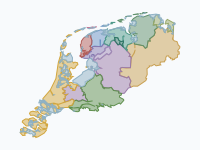
Redbad is the best-known Frisian of the early Middle Ages and one of the least documented. The map follows him and his neighbours from King Aldgisl's winter with an English bishop in 678–679 to the killing of Boniface in 754, on the coast of about AD 800, and keeps the later legends apart, in a colour of their own.
A King Seen Through Other People's Books
Everything we know about Redbad comes from his enemies and from the missionaries who tried to convert his people. Bede (731) and the Lives of Willibrord and Boniface call him king (Bede has rex Rathbed). The Frankish court histories call him duke, or simply 'the pagan', the title they gave every neighbour they claimed. His name is Radbod in the sources, Radboud in Dutch and Redbad in modern Frisian.
The first Frisian king we can date, Aldgisl, is known from a single winter. In the autumn of 678 Wilfrid, the expelled bishop of York, came to Frisia, and Aldgisl received him with honour and let him preach until spring. When Ebroin, mayor of the palace of Neustria, offered a bushel of gold coins for Wilfrid alive or for his head, Aldgisl had the letter read out in his hall at a feast, tore it up and threw it in the fire. Where the hall stood is not known. Redbad followed him at an unknown date (later chronicles make him Aldgisl's son; no early source does). He first appears in the later 680s, when the hermit Wigbert preached to him for two years and won no one.
Dorestad and 'Nearer Frisia'
In 687 Pepin of Herstal won at Tertry and became master of all the Frankish kingdoms. The Frisians had held Utrecht and the trading town of Dorestad since about 650, and Fredegar's continuator, writing around 751, tells Pepin's battle with Redbad in one sentence: they fought at the fort of Dorestad, Pepin won, Redbad fled 'with the Frisians who had got away', and Pepin went home with much spoil. No text gives the year. Bede's remark that by 690 Pepin 'had lately taken Hither Frisia and driven out King Rathbed' points to 689 or 690, the Annals of Xanten have 694 and the Annals of Metz 697, and Dutch scholars today choose 695 or 697. The map shows the battle at 695.
Nor does any account of the battle say what land changed hands. Utrecht was Frankish by about 696, when Pepin gave Willibrord, consecrated archbishop of the Frisians in Rome on 21 November 695, the old fort there as his seat. Dijkstra (2011) gives the Franks the southern Frisian land up to the Old Rhine, with the first churches at Valkenburg and at the Maas mouth soon after. De Langen and Mol (2020) give them only the river land around Utrecht and Dorestad, and call that their hypothesis. Both leave Kennemerland, Texel and everything north of the Old Rhine to Redbad until he died. No source puts the border on the Vlie, as many maps do: that line comes from the Frisian law-book of about 802. The map follows Dijkstra.
Redbad stayed king beyond that line. Willibrord visited his court and was received 'kindly and humbly', though the king's heart stayed hard. On Fositesland, usually taken to be Heligoland, a king whom Alcuin does not name (most read him as Redbad) had lots cast for three days and put one of Willibrord's companions to death for sacrilege. Around 711 'Grimoald took to wife the daughter of Radbod, duke of the Frisians': Pepin's son married Redbad's daughter Theudesinda.
714–719: The Counter-Stroke
In April 714 Grimoald was murdered at Liège, and in December Pepin died. His widow Plectrude kept Pepin's other son, Charles, under guard, and in 715 the Neustrians beat Theudoald's army near Compiègne, chose Ragenfrid as their mayor and made a treaty with 'Duke Radbod'. Some time between December 714 and the summer of 716 Redbad retook Utrecht and Dorestad, and 'the greater part of the churches, which had been under Frankish rule, were laid waste' (Willibald). In March 716 his fleet came up the Rhine to Cologne, about 250 km of river from Dorestad. Charles 'rushed upon the Frisians and suffered very great loss of his companions and got away by flight'. That summer Boniface waited at Utrecht, 'spoke with the king, who had come there', and found no chance to preach.
Redbad, by the Life of Liudger, had been ill for six years and 'his kingdom began to fail'; the Life of Ermino has him gathering 'a very large army' against the Franks, 'who feared him greatly', when he was struck down. He died in 719: every annal gives the year, none gives the place, and no successor is named. Charles then 'added Frisia, Radbod being dead, to his father's realm', with no battle recorded, probably as far as the Vlie.
733–754: Westergo, the Boarn and Boniface
No early text puts Redbad in the terp lands beyond the Vlie, where the Franks fought next. In 733 'Charles came with an army into Wistragou' (Westergo) and took hostages. In 734 he came again with a fleet, 'put out upon the high sea' (the route is a guess) and 'broke into Westergo and Oostergo, islands of the Frisians'. Camped on the river Boarn, he killed Bubo, 'their pagan duke, a deceitful counsellor', and burnt the shrines. Poppo, the name in many books, is a manuscript spelling of Bubo. No source calls him king or ties him to Redbad, and a Frankish writer still has 'the kings of the Frisians' helping Pippin III in 748, so 'the end of the Frisian kingdom' in 734 is a modern way of putting it. Frankish rule now reached about as far as the Lauwers.
In 753 Boniface 'crossed the water which in their tongue is called Aelmere', and on 5 June 754 an armed band killed him and his companions (52 by tradition) at his camp on the river Bordne, between Oostergo and Westergo. Dokkum, where the killing is placed today, is named in texts a generation later. The map closes with 785, when Frankish rule reaches the Weser, and with the law-book of about 802 and its three Frisian lands: Sincfal to Vlie, Vlie to Lauwers, Lauwers to Weser.
Medemblik, the Font and the King Lists
The best-known stories about Redbad were written long after him. The scene at the font, where he pulls back his foot because he would rather join his forefathers in hell than a few poor men in heaven, comes from a Life of Wulfram written at Fontenelle about 800 under a false name; Levison showed in 1910 that its Frisian chapters are useless as history (Wulfram was dead by 703 at the latest). Medemblik as his royal seat first appears in the Divisiekroniek of 1517, and the castle there was built by Count Floris V about 1288 and called 'Radboud' only from the 17th century. Even 'Frisia Magna', one kingdom from the Zwin to the Weser, is a modern picture drawn from the law-book of about 802. Most researchers now see several Frisian rulers side by side, although Dijkstra allows that Redbad's power covered 'a large part of Frisia magna, if not all of it'.
How to Read the Map
The map is drawn on the coast of about AD 800. There is no Zuiderzee yet, only the Almere lake, joined to the sea by the Vlie, which is still a belt of tidal flats and channels. The Middelzee cuts deep between Westergo and Oostergo, which is why the Franks called them islands, and the Old Rhine still reaches the sea at Katwijk. Behind the dunes and the salt marsh lies peat bog, drawn in grey-brown: nobody lived there, so Frisia was a string of islands along the sea. The blue-grey wash is that old water over today's land.
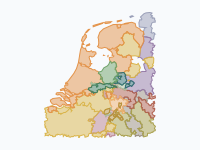
Solid dark blue is the land of the Frisian kings, Aldgisl and Redbad: the Holland coast from the Rhine and Maas mouths to the Vlie, with Utrecht and the river land while they held it. Paler blue is the Frisians under their own leaders, east of the Vlie and along the coast to the Weser, and until about 690 the Maas and Scheldt mouths; no tie between them and the kings is recorded. Ochre is Frankish Austrasia, the darker ochre the Frisian lands the Franks took, and rust is Neustria. Watch the land south of the Old Rhine and the band round Utrecht change hands three times: Frankish at the battle of Dorestad, Redbad's again in 715–716, Frankish for good in 719. Westergo follows in 733, Oostergo in 734.
Discs with thin trails are people and armies: Redbad in blue, Pepin's house in dark red (Charles Martel pale while he is a prisoner), the Neustrians, a Saxon raid and the missionaries in purple. Redbad's disc waits at the Old Rhine mouth as a stand-in, because his seat is unknown. Red pins are battles and campaigns, and the small dark-amber dots are legends. There is no strength bar, because not one figure survives for any of these armies apart from 'about five hundred men' with Charles at Amblève.
How the Map Was Made
The events come from the early texts, from Bede and the Lives of Wilfrid, Willibrord and Boniface to the Frankish histories and annals, checked in November 2026 against editions of the Latin. The modern debate follows Dijkstra (2011) and De Langen and Mol, Mostert and Breternitz in De Vrije Fries 100 (2020). The coast is the Vos map of AD 800 (RCE, CC BY 4.0) for the Netherlands and the modern coast elsewhere, and the land is built from NLGIS municipalities of 1830, German boundaries (BKG VG250) and Natural Earth, so Frankish borders follow modern units. Routes are straight legs between named places. The long Friesland map on this site, from 12 BC to 2019, shows what came before Aldgisl and after the Franks.
Chronological Timeline
- 678–679 — Wilfrid winters with King Aldgisl
- c. 680 — Redbad king of the Frisians (first named in the later 680s)
- c. 690–697 — Pepin beats Redbad at Dorestad (year unknown)
- 21 November 695 — Willibrord consecrated archbishop of the Frisians
- c. 711 — Theudesinda, Redbad's daughter, marries Grimoald
- 715–716 — Redbad retakes Utrecht and Dorestad
- March 716 — Redbad's fleet at Cologne; Charles Martel beaten
- 719 — Redbad dies; Charles Martel takes Frisia
- 733 — Charles Martel's army in Westergo
- 734 — Battle of the Boarn: Bubo killed
- 5 June 754 — Boniface killed near Dokkum
- c. 802 — The Frisian law-book names three Frisian lands
- 1517 — A Holland chronicle first puts Redbad's seat at Medemblik
Follow Redbad's fleet up the Rhine to Cologne in March 716, then Charles Martel's fleet over the Almere and the Vlie to the Boarn in 734. The map can also be embedded on your own site or exported as an animated GIF.
Explore the full interactive map →Frequently asked questions
- Who was Redbad (Radbod), king of the Frisians?
- A pagan Frisian ruler who followed King Aldgisl at an unknown date and died in 719. Bede and the Lives of the missionaries call him king (Bede writes rex Rathbed); the Frankish court histories call him duke, or simply 'the pagan'. He first appears in the later 680s, lost Dorestad and Utrecht to Pepin of Herstal in the 690s, saw his daughter Theudesinda marry Pepin's son Grimoald, took the lost land back after Pepin's death and beat Charles Martel at Cologne in March 716. Where he lived is not known.
- Did Redbad defeat Charles Martel?
- Yes. In March 716 Redbad 'came by ship as far as the city of Cologne', and Charles Martel, a few months out of prison, attacked the Frisians and 'suffered very great loss of his companions and got away by flight' (Book of the History of the Franks, 727). Two small annals put the fight at Cologne; the exact field is not named. It is usually called the only battle Charles Martel lost.
- When was the battle of Dorestad, and what did Redbad lose?
- No text gives the year. Bede's 'lately' points to 689 or 690, the Annals of Xanten have 694 and the Annals of Metz 697, and Dutch scholars today choose 695 or 697. Fredegar's continuator says only that Pepin won at the fort of Dorestad and went home with much spoil. Pepin held Utrecht by about 696. Dijkstra thinks the Franks took the land up to the Old Rhine; De Langen and Mol give them only the river land around Utrecht and Dorestad. No source puts the new border on the Vlie.
- Where did Redbad live and die? Was it Medemblik?
- Nobody knows. The annals give the year of his death, 719, but no text names the place, and none names his seat. Medemblik as his royal seat first appears in the Divisiekroniek, a Holland chronicle of 1517. The castle there was built by Count Floris V about 1288 and was called 'Radboud' only from the 17th century.
- Did Redbad refuse to be baptised?
- That is a legend. The scene at the font, where Redbad pulls back his foot because he would rather join his forefathers in hell than a few poor men in heaven, comes from a Life of Wulfram written at Fontenelle about 800 under a false name. Levison showed in 1910 that its Frisian chapters are useless as history, and Wulfram was dead by 703 at the latest. The early sources record only that Redbad received Willibrord kindly at his court and that his heart stayed hard.
- Who was Poppo (Bubo), and what was the battle of the Boarn?
- In 734 Charles Martel's fleet put to sea, broke into Westergo and Oostergo, 'islands of the Frisians', and camped on the river Boarn. There he killed Bubo, 'their pagan duke, a deceitful counsellor', and burnt the shrines. Poppo is a manuscript spelling of the same name. No source calls Bubo a king or ties him to Redbad. Frankish rule now reached about as far as the Lauwers.
- Is there an animated map of Redbad and the Frisian kingdom?
- Yes. Moving Polygons has a free animated map of Redbad and his wars with the Franks, from c. 650 to the Frisian law-book of c. 802, in 78 keyframes. It is drawn on the coast of about AD 800, with the Almere lake, the Vlie and the Middelzee, shows the kings' land in solid dark blue and the Frisians under their own leaders in a paler blue, and follows Redbad, Pepin's house, the Neustrians and the missionaries as moving discs. You can watch it, embed it on your website or export it as an animated GIF.
Text version of the map (timeline, layers and events): Markdown