In the spring of 58 BC the Helvetii burned their own towns and gathered on the Rhône to move west through the Roman province. Its new governor hurried from Rome to Geneva, broke the bridge and dug a wall 19 miles long from the lake to the Jura. Seven years later Rome held all Gaul from the Pyrenees to the Rhine and the Ocean. By 45 BC Julius Caesar had also won a civil war fought from Spain to Thessaly and Africa, and on 15 March 44 BC some sixty senators killed him.
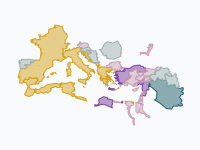
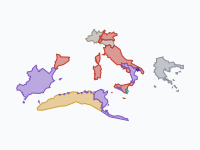
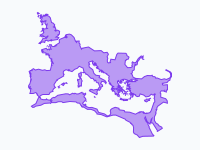
The map follows him from 59 BC to the Ides of March, Gaul people by people and then the Roman world province by province, showing who actually obeyed him each year. Its frames are dated by the sun, and by the sun Caesar crossed the Rubicon in late November.
58–56 BC: Helvetii, Ariovistus, the Belgae and the Veneti
Caesar's army came out of a political deal. In 60 or early 59 BC (the ancient writers differ) he made a private pact with Pompey and Crassus, and as consul in 59 he got a law that gave him Cisalpine Gaul and Illyricum for five years; the Senate added Transalpine Gaul. The first frame shows free Gaul in slate blue, the Aedui as friends of Rome in dusty pink, and in grey the German king Ariovistus, who held a third of the land of the Sequani in Alsace.
Caesar's count of the Helvetii (368,000 people, 92,000 of them fighters) is thought far too high; Delbrück reckoned about 12,000 fighters. Caesar beat them near Bibracte, drove Ariovistus over the Rhine after a battle whose field has never been found, and wintered six legions at Vesontio (Besançon), the first Roman army to winter in free Gaul. In 57 the Remi joined him and stayed loyal to the end, the Belgic league broke up at the Aisne, and at the Sabis the Nervii burst from the woods on legions still making camp; Caesar says only 500 of 60,000 Nervian fighters were left, yet they had an army in the field again in 54. In 56, after the three partners renewed their pact at Luca, Decimus Brutus' galleys destroyed the fleet of the Veneti off the Atlantic coast, and Caesar killed their council and sold the people.
The pale salmon patch over central Gaul from 57 marks peoples such as the Arverni, Bituriges and Senones, who never fought Caesar before 52 but sent him hostages and cavalry. Drawn free, their revolt in 52 would look odd; drawn conquered, they would be false.
55–53 BC: Bridges, Britain and Ambiorix
In 55 Caesar fell on two German peoples, the Usipetes and Tencteri, during talks; he counts 430,000 of them, the team that dredged up their skeletons at Kessel on the Meuse speaks of 150,000 to 200,000 dead, and other scholars think far fewer. He bridged the Rhine in ten days and landed in Britain twice, with two legions in August 55 and with five in 54, when he forded the Thames and made Cassivellaunus promise a tribute. He left no garrison, and Britain and Germany are never coloured Roman on the map. In the autumn of 54 Ambiorix of the Eburones lured Sabinus and Cotta out of their winter camp at Aduatuca and destroyed fifteen cohorts, the worst Roman loss of the war, and the north-east turns orange. In 53 Caesar bridged the Rhine again and let every neighbour plunder the Eburones, while in the east Crassus died after his defeat at Carrhae. Julia, Caesar's daughter and Pompey's wife, had died the summer before, and the pact of three was now a contest of two.
52–51 BC: Vercingetorix
In the winter of 53/52 the Carnutes killed the Roman traders at Cenabum (Orléans), and the young Arvernian Vercingetorix raised central and western Gaul. Caesar crossed the snowbound Cevennes and stormed Avaricum (Bourges), where by his account barely 800 of 40,000 got away. At Gergovia his men ran on to the town wall and were thrown back, and the Aedui, Rome's oldest allies in Gaul, changed sides. Most of Gaul turns orange: only the Remi, the Lingones and the Treveri stayed away from the council that confirmed Vercingetorix as commander.
He fell back on Alesia, and Caesar ringed it with an inner line of 11 miles and an outer one of 14. Caesar writes of 80,000 men inside and a relief army of 250,000 foot; modern estimates run from 20,000 to 80,000 inside and 50,000 to 100,000 outside. The relief army attacked three times and was broken, and Vercingetorix surrendered. In 51, at Uxellodunum, Caesar cut off the defenders' spring by tunnelling and had the hands of everyone who had borne arms cut off. From then on Gaul is crimson, except the Aedui, Remi and Lingones, who kept the name of allies.
What it cost is unknowable. Plutarch, passing on Caesar's own boasts, says three million fought him, a million were killed and a million enslaved; Pliny gives 1,192,000 killed in Caesar's foreign wars and Velleius more than 400,000. Modern historians find none of these numbers credible (Henige, 1998): the battle dead may have run to tens of thousands, with a civilian toll no one can count. The map gives both in one pin, and it has no casualty bar.
49–48 BC: From the Rubicon to Pharsalus
The Senate voted 370 to 22 that Caesar and Pompey should both disarm, then passed its emergency decree and ordered Caesar to disband. On the night of 10 January 49 he crossed the Rubicon with one legion, about 5,000 foot and 300 horse, and took Ariminum before dawn. Labienus, his best legate in Gaul, went over to Pompey, and his disc turns green. Corfinium surrendered and Caesar let its senators go, Pompey sailed from Brundisium for Epirus, and in about sixty days Caesar held Italy without a battle.
The war then split into theatres. In Spain Caesar ran Afranius and Petreius down near Ilerda until their five legions surrendered; Massilia shut its gates and fell after a six-month siege; Cato gave up Sicily to Curio, who crossed to Africa and died with his army at the Bagradas against King Juba. In January 48 (Roman) Caesar slipped across to Epirus. At Dyrrhachium Pompey broke out of the 17 miles of works Caesar had built around him and Caesar's counter-attack ended in panic, but at Pharsalus on 9 August (Roman) Caesar hid a fourth line of cohorts behind his right, and it routed Pompey's 7,000 cavalry and rolled up his line. Caesar claims 15,000 Pompeians killed and 24,000 taken; Asinius Pollio gives 6,000 dead.
48–44 BC: Egypt, Pontus, Africa, Spain and the Ides
Pompey fled to Egypt and was stabbed in the landing boat at Pelusium on the orders of the boy king's ministers. Caesar arrived three days later with 3,200 foot and 800 horse and was soon besieged in the palace quarter of Alexandria, where he burnt the fleet in the docks (how much of the Library burned with it is disputed) and held out until a relief army came; Ptolemy XIII drowned at the battle of the Nile, and Cleopatra ruled with a younger brother. Pharnaces, son of Mithridates the Great, had meanwhile taken Pontus (orange on the map), and in 47 Caesar destroyed his army at Zela in a campaign of five days: "I came, I saw, I conquered".
Africa came next. Caesar landed with 3,000 foot and 150 horse, was nearly destroyed by Labienus' cavalry at Ruspina, and won at Thapsus on 6 April 46 (Roman): 10,000 Pompeian dead in the African War, 50,000 in Plutarch. Cato fell on his sword at Utica rather than be pardoned. In Spain Pompey's sons raised thirteen legions, and Caesar beat them at Munda on 17 March 45, the last battle of the war ("elsewhere I fought for victory, here for my life"); Gnaeus Pompey was hunted down, Sextus escaped. Dictator for eleven days in 49, for a year in 48, for ten years in 46 and by 15 February 44 for life, Caesar meant to leave on 18 March for a war on the Dacians and Parthia. On the Ides some sixty senators led by Brutus and Cassius stabbed him 23 times in the hall of Pompey's theatre, and his disc fades from the map.
A Calendar Two Months Ahead of the Sun
Before Caesar's reform the Roman year had 355 days, kept level with the sun by an extra month in some years, and by the 40s BC it ran up to two months ahead. With Chris Bennett's tables the Rubicon's "10 January 49 BC" becomes about 21 November 50 BC by the sun, and Pharsalus' "9 August 48" becomes 5 June (older tables put both two days later). To set it right Caesar, as chief priest and advised by Sosigenes of Alexandria, added two extra months to 46 BC on top of the usual one, so that year had 445 days. From 1 January 45 the year had 365 days and a leap day every fourth year: the Julian calendar.
The map runs on sun dates, while its captions keep the famous Roman month ("Jan 49 BC (Roman)" over a frame in late November 50) and its pins give both dates. For the 50s the sources give seasons rather than days, and which of those years had an extra month is disputed, so the frames of 59 to 51 BC show only the year and the season is in the caption ("Summer 57 BC").
How to Read the Map
Crimson is Caesar: his provinces, his conquests and from 49 his whole side. Dusty pink is Rome's allies and client kings (the Aedui, Remi and Lingones, Massilia, Egypt, Numidia), pale salmon the Gauls who took his orders unfought (a flat patch sewn on, in this embroidered tapestry style), orange anyone in arms against him and slate blue free Gaul. Grey-brown is the Senate's governors before the war, green Pompey and the Senate, teal Parthia. The discs are people with their armies or fleets, sized by their strength: Caesar is the large crimson one with a trail of his marches, Vercingetorix is orange, and Pompey, Cato and Pompey's sons are green. A disc fades when its person dies or leaves the story. Red pins mark battles and sieges; there are 87 frames and 110 pins.
How the Map Was Made
The dates, places and numbers come from a fact-checked research file built on Caesar's commentaries and the Alexandrian, African and Spanish Wars, on Plutarch, Suetonius, Appian, Cassius Dio, Velleius and Pliny, and on the attalus.org year pages. The Gallic peoples are built from modern French departments, Belgian provinces and Swiss cantons, so their borders are coarse; the other borders come from Natural Earth and Cliopatria (Seshat Global History Databank), and the coasts are modern. Disputed sites are drawn at one candidate, with the dispute in the pin: Aduatuca (Tongeren, Caestert near Maastricht or elsewhere), the Sabis (now usually the Selle rather than the Sambre), Portus Itius (Boulogne or Wissant), the landing beach in Britain (Walmer and Deal by tradition, or Pegwell Bay, where a 2017 dig found a defended Roman base) and Munda (La Lantejuela, now favoured over Montilla and Monda).
This is the first of two maps. A second map continues the story, following Antony, Octavian and the others from the Ides of March to 27 BC.
Chronological Timeline
- 60 or early 59 BC: Caesar, Pompey and Crassus make their pact
- 58 BC: Helvetii beaten near Bibracte; Ariovistus driven over the Rhine
- 57 BC: the Belgae beaten at the Aisne and the Sabis
- 56 BC: Luca; the Veneti fleet destroyed
- 55–54 BC: Rhine bridge; two landings in Britain
- 54–53 BC: Ambiorix's rising; Crassus killed after Carrhae
- 52–51 BC: Avaricum, Gergovia, Alesia and Uxellodunum
- 10 January 49 BC (Roman; about 21 November 50 BC by the sun): the Rubicon
- 49 BC: Corfinium, Ilerda, Massilia and the Bagradas
- 48 BC: Dyrrhachium; Pharsalus; Pompey murdered
- 48–47 BC: the Alexandrian War; Zela
- 46 BC: Thapsus; Cato dies; the 445-day year
- 17 March 45 BC: Munda
- 15 March 44 BC: the Ides of March
Follow Caesar from Geneva to Alesia, across the Rubicon and on to the Ides of March.
Open the animated map →Frequently asked questions
- What was the Gallic War?
- Julius Caesar's conquest of Gaul, from 58 to 51 BC. It began when he stopped the migration of the Helvetii at Geneva and beat them near Bibracte, went on against the German king Ariovistus, the Belgae (at the Aisne and the Sabis), the Veneti at sea, two landings in Britain and the rising of Ambiorix, and peaked in 52 BC with the revolt of Vercingetorix, who surrendered after Caesar ringed Alesia with two lines of siege works. The last defenders gave in at Uxellodunum in 51. By then Rome held all Gaul from the Pyrenees to the Rhine and the Ocean; the Aedui, Remi and Lingones kept the name of allies.
- How many people died in Caesar's conquest of Gaul?
- Nobody knows. The ancient totals go back to Caesar's own boasts: Plutarch says three million fought him, a million were killed and a million enslaved, Pliny gives 1,192,000 killed in his foreign wars and Velleius more than 400,000. Modern historians find none of these numbers credible (Henige, 1998): the battle dead may have run to tens of thousands, with a civilian toll no one can count.
- When did Caesar cross the Rubicon?
- On the night of 10 January 49 BC by the Roman calendar, with one legion of about 5,000 foot and 300 horse; he took Ariminum before dawn. The Roman calendar then ran up to two months ahead of the sun, and converted with Chris Bennett's tables the crossing fell on about 21 November 50 BC by the sun. Older tables put it two days later.
- How did Caesar win the civil war against Pompey?
- He took Italy in about sixty days without a battle in 49 BC, forced Pompey's legates in Spain to surrender near Ilerda and took Massilia after a six-month siege, while his man Curio was killed in Africa. In 48 he crossed to Epirus, was beaten at Dyrrhachium and then won the decisive battle at Pharsalus, where a hidden fourth line of cohorts routed Pompey's 7,000 cavalry. Pompey was murdered in Egypt. Caesar then fought the Alexandrian War, beat Pharnaces at Zela in 47, destroyed the Pompeians in Africa at Thapsus in 46 and beat Pompey's sons at Munda in Spain on 17 March 45 BC.
- Why did the year 46 BC last 445 days?
- Before Caesar's reform the Roman year had 355 days, with an extra month in some years, and by the 40s BC it ran up to two months ahead of the sun. As chief priest, advised by Sosigenes of Alexandria, Caesar added two extra months to 46 BC on top of the usual one, so that year lasted 445 days. From 1 January 45 BC the year had 365 days and a leap day every fourth year: the Julian calendar.
- Is there an animated map of Caesar's Gallic War and civil war?
- Yes. Moving Polygons has a free animated map, Caesar: the Conquest of Gaul and the Civil War, 59–44 BC, with 87 frames and 110 pins. It colours each Gallic people by whether it was an ally, took Caesar's orders without a fight, was conquered or had risen, then every province and client kingdom by the side it obeyed in the civil war, with Caesar, his legates and his enemies as moving discs. It is dated by the sun, and a second map continues the story after the Ides of March. You can watch it for free and embed it on your website.
Text version of the map (timeline, layers and events): Markdown