Two Pale Dots, Around the Year 30
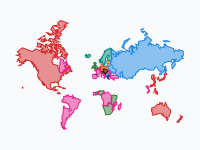
The first frame of this map, around the year 30, has two pale dots, on Jerusalem and Galilee. In the last, colour covers the Americas, most of Europe, Russia to the Pacific, Australia and much of Africa south of the Sahara, while Anatolia, where Paul founded some of his first congregations, is all but blank. In 1910 two in three Christians lived in Europe; by 2010 one in four (Pew Research Center).
The map follows that in 47 keyframes and seven layers: six branches of the faith, and one for the places that have since left religion behind. A coloured area means that this branch was the dominant form of Christianity there or had a substantial community, not that everyone there was Christian.
From Paul's Cities to the Emperor's Church, 30–380
For two and a half centuries the map has only small circles for city congregations: in Asia Minor and Greece after Paul's journeys of the late 40s and 50s, in Rome (where Nero persecuted the Christians in 64) and, by the frame captioned 'c. 200 · From Lyon to Edessa', in Gaul, Spain and North Africa.
Armenia fills in first. King Tiridates III was baptised by Gregory the Illuminator, in 301 by Armenian tradition and around 314 according to most historians; Armenia is usually counted as the first state to adopt the faith. In February 313 Constantine and Licinius agreed at Milan that Christians could worship freely, and on 27 February 380 Theodosius I and his co-emperors made Nicene Christianity the religion of the Roman state (the Edict of Thessalonica). Between those frames the circles merge into solid red in the Latin west and yellow in the Greek east. King Ezana of Aksum, in today's northern Ethiopia, converted in the 330s and the king of Iberia (eastern Georgia) about the same time.
Splits in the East, Arian Kings in the West, 410–720
Blue, from the 410 frame, is the Church of the East, the church of the Persian Empire, independent of the patriarchs in the Roman world from 424. It spread along the trade routes: the monk Alopen reached the Chinese capital Chang'an in 635, and blue circles run from Mesopotamia to Kerala, Samarkand and, under the Mongols, Khanbaliq (Beijing). After 1368 the Ming expelled Christians from China, Timur devastated the heartland, and by 1400 blue is down to the mountains around Mosul and to Kerala.
Purple dates from 451, when the Council of Chalcedon defined Christ as one person in two natures. The churches of Egypt, Armenia and Ethiopia and many Syriac Christians rejected the formula and became the Oriental Orthodox churches; until then the map draws them yellow. Nubia joined them in the sixth century and stays purple until about 1500; Egypt's Copts and the Ethiopian church are purple to the last frame.
Pink is the creed of the Germanic kings. The Goths took their Christianity from Wulfila, bishop from around 341, in the Arian form condemned at Nicaea in 325. When the western empire fell in 476, Arian kings ruled Spain, southern Gaul and North Africa, and by 500 Italy, over populations that mostly stayed Catholic. Clovis, king of the Franks, was baptised a Catholic instead (in 496 by tradition, perhaps as late as 508). The Visigoths gave up Arianism in 589, and by the 700 frame the pink is gone.
The map has no colour for Islam or any other religion: where Christianity stops being the main faith, the land goes blank. Arab armies took Jerusalem in 638 and Carthage in 698 and crossed to Spain in 711. Spain empties in the 720 frame, except for the north and circles at Toledo, Córdoba and Mérida, and by 800 North Africa's red is down to a patch around Carthage. Syria and Egypt keep their colour far longer: Christians there, says the map's note at 638, 'remain the majority for centuries, but slowly shrink'.
Baptised Kings and Crusades: Europe, 432–1387
North of the old Roman frontier the faith usually came from the top: a ruler was baptised and his people followed, by choice or otherwise. Ireland, never Roman, was converted in the fifth century (Patrick's mission is traditionally dated 432), and in 597 Augustine, sent by Pope Gregory, landed in Kent. The Saxons were converted by war: Charlemagne fought them from 772 to 804, had 4,500 beheaded at Verden in 782 and made refusing baptism a capital offence.
The fastest change comes around 1000. Boris of Bulgaria was baptised in 864 or 865, Mieszko of Poland in 966 and Vladimir of Kiev in 988; Vladimir chose the church of Constantinople, which is why Rus' is yellow. Stephen of Hungary was crowned at the turn of 1000–1001 and Iceland's Althing chose the new faith in 1000. In 1054 the pope's legate and the patriarch of Constantinople excommunicated each other; the break became lasting after crusaders sacked Constantinople in 1204.
Europe's last pagans lived around the Baltic, and most were converted by conquest. From the Wendish Crusade of 1147 on, crusading armies subdued Wends, Livonians, Estonians, Finns and Prussians: watch the red move along the coast in the 1200, 1250 and 1300 frames. Lithuania, the last pagan state in Europe, held out until 1387, after Grand Duke Jogaila had accepted baptism as a condition of the Polish crown.
Reformation and Counter-Reformation, 1415–1839
Green appears a century before Luther. Jan Hus was burned at Constance on 6 July 1415 and his followers held Bohemia, green from the 1420 frame. After Luther's theses of 31 October 1517 it spreads from Saxony: the Duchy of Prussia became the first Protestant state in 1525, England broke with Rome in 1534 and Denmark–Norway turned Lutheran in 1536–1537.
Pause on 'c. 1580 · Height of the Reformation': green reaches through Bohemia and Austria into Hungary. By 1650 most of that is red again; in Bohemia the Habsburgs reimposed Catholicism after the battle of White Mountain in 1620. Three green circles in France (La Rochelle, Montauban, the Cévennes) are the Huguenots; after Louis XIV revoked the Edict of Nantes in 1685 only the Cévennes is left. Further east the Union of Brest (1596) put Orthodox bishops of Poland–Lithuania under the pope: Galicia and Belarus turn red, Belarus only until the Synod of Polotsk in 1839.
Across the Oceans and South, 1491–2025
Outside Europe the faith travelled with ships and armies. Portuguese priests baptised the king of Kongo on 3 May 1491 (a red circle in 1492). In the Americas, as the pin for 1524 says, 'conquest and conversion go together': a papal bull of 1493 gave Castile the newly found lands and urged it to bring their peoples to the faith, and twelve Franciscans reached Mexico in 1524. Red spreads from Hispaniola over Mexico, Peru and the Brazilian coast by 1560; Latin America became Catholic, says the map's note on Columbus, 'often by force'.
In Japan the mission that Francis Xavier began in 1549 reached some 300,000 Christians before the ban of 1614; Nagasaki's red circle is in the 1600 frame only. Protestant settlers add green in New England, Virginia and at the Cape (the Dutch landed in 1652), and Russian expansion carries yellow across Siberia to Kodiak in Alaska, where monks began a mission in 1794. In what the 1880 caption calls 'The missionary century', mission societies followed traders and colonial armies into Africa, Asia and the Pacific. The 1900 caption reads 'Africa only c. 10% Christian'.
The twentieth century emptied old Christian homelands. In the Ottoman Empire around a million Armenians were killed from 1915, and with them Syriac and Assyrian Christians (the Sayfo); the exchange of populations agreed with Greece in 1923 removed about 1.2 million Orthodox Christians from Turkey. In the 1923 frame Anatolia's yellow and blue are gone. After 1945 some twelve million Germans fled or were expelled from the east, and Protestant Pomerania, Silesia and East Prussia turn Catholic red.
Sub-Saharan Africa went from 9% Christian in 1910 to 63% in 2010, and most of its colour arrives between the 1950 and 2000 frames. Pew's 2025 report counted 2.3 billion Christians in 2020, 28.8% of the world's people: 31% of them in sub-Saharan Africa, more than in any other region, 24% in Latin America and the Caribbean and 22% in Europe. Translucent grey marks the opposite trend, where censuses and surveys find a majority with no religion: eastern Germany, Czechia and Estonia from 2000, and by 2025 the Netherlands (since 2017), Scotland (51.1% in the 2022 census), New Zealand (51.6% in 2023) and British Columbia (52.1% in 2021).
How to Read the Map
Red is 'Latin church → Roman Catholic' and yellow 'Greek church → Eastern Orthodox'. The arrows mean that until 1054 these are the western and eastern halves of one church, in the same two colours, so nothing changes colour in the 1054 frame. Purple is 'Oriental Orthodox (Coptic, Armenian, Ethiopian, Syriac)', blue 'Church of the East ("Nestorian", Syro-Persian)', pink 'Arianism (Gothic and Germanic kingdoms)', green 'Protestant (Hussite, Lutheran, Reformed, Anglican, Evangelical)', and translucent grey 'Secularised: non-religious majority', laid over the branch colour underneath.
A coloured area claims only that the branch was the dominant form of Christianity there or had a substantial community. It hides minorities: Northern Ireland turns from green to red in the last frame because the 2021 census counted 42% Catholics and 37% Protestants. Small circles are communities in a non-Christian setting; where two colours overlap, as in Switzerland, both branches live side by side. Colonial colour follows the colonial core, and under communist rule the colour shows the inherited tradition, not practice. The 20 pins and 41 smaller dots carry the events.
How the Map Was Made
The areas are built from modern national and provincial borders (Natural Earth and A. Ourednik's historical-basemaps), used as an approximation, in the vintage-soft style. The Church of the East follows Baumer's The Church of the East; the recent frames rest on Pew Research Center's Global Christianity (2011) and later studies, Statistics Netherlands, censuses from Northern Ireland to New Zealand, and CID Gallup and Latinobarómetro polls for Central America.
Modern borders give empty land the colour of its present owner: Svalbard turns red with Norway around 1000, six centuries before it was discovered in 1596. Dates before 1500 are rough estimates. Under Muslim rule (827–1091) Sicily keeps colour only in its north-east, a rough stand-in for the Greek-rite Christians of the Val Demone. Coasts and the seams between two branches are coarse, so a strip of land along some shores and thin wedges on some borders stay uncoloured. The Huguenots appear only as three circles, although Normandy had Protestant communities too.
Chronological Timeline
- c. 30 — First congregation in Jerusalem
- 301 (tradition; c. 314) — Armenia's king baptised
- 313 — Free worship in the Roman Empire
- 380 — Nicene Christianity the Roman state religion
- 496 (tradition) — Clovis baptised
- 638–711 — Arab conquests from Jerusalem to Spain
- 988 — Vladimir of Kiev baptised
- 1054 — Rome and Constantinople excommunicate each other
- 1492 — Columbus reaches America
- 1517 — Luther's Ninety-five Theses
- 1915–1923 — Armenian genocide, Sayfo, population exchange
- 2020 — 2.3 billion Christians worldwide
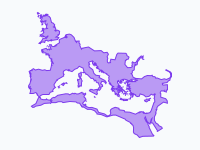
The empire that adopted the faith in 380 has its own map, from 509 BC to 1453.
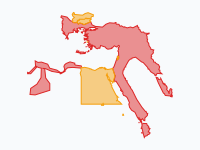
Read: The Roman Empire from 509 BC to 1453 →The same three blocs decided who accepted the pope's calendar, and when (1582–1923).
Read: Why It Took Europe 341 Years to Agree on the Date →Play the map from the two dots of AD 30 to the grey of 2025, and click the pins for the story behind each change.
Explore the full interactive map →Frequently asked questions
- When did Christianity spread to Europe?
- In the first century. Paul's journeys of the late 40s and 50s founded congregations in Greece, there were Christians in Rome by 64, when Nero persecuted them, and by about 200 there were congregations as far west as Lyon and Spain. The Roman Empire allowed the faith in 313 and made it the state religion in 380. North of the old Roman frontier it mostly came through rulers: Ireland in the fifth century, the Franks under Clovis (496 by tradition), Kent from 597, the Saxons through Charlemagne's wars of 772–804, Poland in 966, Kievan Rus' in 988, Hungary and Iceland around 1000. The peoples around the Baltic were converted by crusades from 1147, and Lithuania, the last pagan state in Europe, was baptised in 1387.
- Which country was the first to adopt Christianity?
- Armenia is usually counted as the first state to adopt Christianity. King Tiridates III was baptised by Gregory the Illuminator in 301 according to Armenian tradition; most historians prefer a date around 314. King Ezana of Aksum, in the north of today's Ethiopia, converted in the 330s and the king of Iberia (eastern Georgia) at about the same time. The Roman Empire made Nicene Christianity its state religion in 380.
- When did the Roman Empire become Christian?
- In two steps. In February 313 the emperors Constantine and Licinius agreed at Milan that Christians could worship freely (the Edict of Milan). On 27 February 380 Theodosius I and his co-emperors issued the Edict of Thessalonica, which made Nicene Christianity the religion of the Roman state. Armenia had got there first: its king was baptised in 301 by tradition, around 314 according to most historians.
- How did Christianity spread to the Americas?
- With European conquest and settlement. Columbus reached America in 1492, a papal bull of 1493 gave Castile the newly found lands and urged it to bring their peoples to the faith, and twelve Franciscans began the mission in Mexico in 1524. Spanish and Portuguese America became Catholic, often by force. Protestant settlers brought their churches to New England and Virginia, and Russian monks began an Orthodox mission on Kodiak in Alaska in 1794.
- How did Christianity spread in Africa?
- The churches of Egypt and Ethiopia go back to antiquity: the king of Aksum, in the north of today's Ethiopia, converted in the 330s, and Nubia followed in the sixth century. After the Arab conquests of the seventh century Christianity faded in North Africa, and Christian Nubia ended around 1500, but the Coptic and Ethiopian churches survive. Portuguese priests baptised the king of Kongo in 1491, and in the nineteenth century mission societies followed traders and colonial armies inland. Most of the growth is recent: sub-Saharan Africa went from 9% Christian in 1910 to 63% in 2010, and in 2020 it held 31% of the world's Christians, more than any other region (Pew Research Center).
- How many Christians are there in the world?
- About 2.3 billion in 2020, or 28.8% of the world's population, according to Pew Research Center's 2025 study of the global religious landscape. Of those, 31% lived in sub-Saharan Africa, 24% in Latin America and the Caribbean and 22% in Europe. In 1910 two in three Christians lived in Europe.
- Is there an animated map of the spread of Christianity?
- Yes. Moving Polygons has a free animated map, Spread of Christianity, 30–2025, that follows the faith from Jerusalem across the world in 47 keyframes. Seven layers show the branches: the Latin church, later Roman Catholic, in red; the Greek church, later Eastern Orthodox, in yellow; Oriental Orthodox in purple; the Church of the East in blue; Arianism in pink; Protestant in green; and in translucent grey the places where a majority now has no religion. 20 pins and 41 smaller dots mark the councils, baptisms, conquests and missions. You can watch it, embed it on your own website or export it as an animated GIF.
Text version of the map (timeline, layers and events): Markdown