In December 1793 a 24-year-old artillery officer from Corsica planned the batteries that drove the British fleet out of Toulon. In July 1815 the same man surrendered to a British captain off Rochefort, and in between he had dissolved the Holy Roman Empire, put three of his brothers on four thrones, led more than 400,000 men into Russia and lost almost all of them. This animated map follows Napoleon Bonaparte's career from Toulon to his death on St Helena in May 1821, and shows what his wars did to the map of Europe and what they cost.
From Toulon to First Consul (1793–1799)
Revolutionary France was at war with most of Europe when royalist Toulon opened its port to a British and Spanish fleet in August 1793. Bonaparte, commanding the artillery of the besieging army, saw that the forts above the harbour were the key: Fort Mulgrave fell on 17 December, the Allied ships left, and the city was retaken on 19 December. He was promoted brigadier general three days later. On 5 October 1795 (13 Vendémiaire), days after France annexed Belgium, he crushed a royalist rising in Paris with grapeshot, and in March 1796 he was given command of the Army of Italy.
The Italian campaign made him famous. He split the Piedmontese from the Austrians at Montenotte in April 1796, forced Sardinia out of the war, took the bridge at Lodi and entered Milan in May. Four Austrian relief armies failed to save Mantua, which surrendered in February 1797, and the Pope signed away Bologna, Ferrara and the Romagna at Tolentino. By April his vanguard stood at Leoben, about 130 km from Vienna. At Campo Formio in October 1797 Austria recognised the new Cisalpine Republic, gave up Belgium and accepted Venice, a thousand-year-old republic that Bonaparte had ended that spring, as compensation. Sister republics followed in Rome and Switzerland in 1798 and in Naples in January 1799.
In May 1798 he sailed for Egypt with about 38,000 men. He took Malta on the way, beat the Mamluks at the Pyramids on 21 July and entered Cairo, but Nelson destroyed his fleet in Aboukir Bay ten days later and his march into Syria broke down before the walls of Acre in May 1799. Meanwhile an Austro-Russian army under Suvorov took back almost all of northern Italy. Bonaparte left his army in Egypt, landed at Fréjus in October and overthrew the Directory in the coup of 18 Brumaire (9–10 November 1799).
The Empire Builder (1800–1807)
As First Consul he crossed the Alps and won Italy back at Marengo in June 1800, and Moreau's victory at Hohenlinden in December forced Austria to accept the Rhine as France's border at Lunéville. The army left in Egypt surrendered in 1801, and in March 1802 even Britain made peace at Amiens. It lasted fourteen months. Piedmont was annexed to France in September 1802, and when war resumed in 1803 France occupied Hanover, the British king's German electorate. Napoleon crowned himself Emperor of the French in Notre-Dame on 2 December 1804 and King of Italy the following May, and annexed Genoa.
In 1805 the camp at Boulogne marched to the Danube: Mack's army capitulated at Ulm on 20 October, the day before Nelson destroyed the Franco-Spanish fleet off Trafalgar, and on 2 December Napoleon broke the Russian and Austrian armies at Austerlitz. The Peace of Pressburg took Venetia, Tyrol and Austria's Swabian lands. In 1806 Joseph became King of Naples, Louis King of Holland, sixteen German princes formed the Confederation of the Rhine under French protection, and on 6 August the Holy Roman Empire came to an end. Prussia went to war that autumn and was destroyed at Jena and Auerstedt; Napoleon rode into Berlin on 27 October. After Eylau and Friedland, the treaties of Tilsit in July 1807 halved Prussia: its western lands became the Kingdom of Westphalia under Jérôme Bonaparte and its Polish lands the Duchy of Warsaw.
The Spanish Ulcer and the Empire at Its Peak (1807–1811)
To close Europe to British trade, Junot occupied Portugal in late 1807. Madrid rose against the French on 2 May 1808; days later Napoleon forced the Spanish Bourbons to abdicate at Bayonne and made Joseph King of Spain, and Tuscany was annexed to France. A French army capitulated at Bailén in July, a British one landed in Portugal, and the war that followed, fought by regular armies, Wellington's Anglo-Portuguese and Spanish guerrillas, never ended until the French were driven over the Pyrenees in 1813. The map shows the area the French actually held at each moment, which was never the whole of Spain.
Austria tried again in 1809. Napoleon took Vienna in May, lost his first pitched battle at Aspern-Essling, and won at Wagram in July; the Treaty of Schönbrunn took Salzburg, western Galicia and the Adriatic coast, which became the Illyrian Provinces of the French Empire. The Papal States were annexed that May. In 1810 Napoleon married the Austrian archduchess Marie Louise, annexed the Kingdom of Holland, and in December the North Sea coast up to Lübeck. At the start of 1811 France had 130 départements, from Hamburg and Lübeck to Rome. Around it lay the Bonaparte kingdoms (Italy, Naples, Westphalia and Joseph's Spain), the Duchy of Warsaw, Switzerland under Napoleon's Act of Mediation and the Confederation of the Rhine, and in 1812 even Austria and Prussia had to send army corps to march with him.
Moscow, Leipzig and Waterloo (1812–1815)
When Russia left the Continental System, Napoleon invaded. The main body of the Grande Armée, about 422,000 men with Polish, German, Italian and other contingents, crossed the Niemen on 24 June 1812. On the map the dark blue disk is that army, its area proportional to its strength: it shrinks with every week of the advance, fights the bloodiest single day of the wars at Borodino on 7 September, enters an abandoned Moscow with about 100,000 men a week later and leaves it on 19 October. By the time the survivors had crossed the Berezina at the end of November it was a fraction of that, and only about 10,000 men of the main body recrossed the Niemen in mid-December.
Prussia changed sides in March 1813 and Austria in August. Napoleon won at Lützen, Bautzen and Dresden with a newly raised army, but lost the four-day Battle of the Nations at Leipzig in October 1813, and the Confederation of the Rhine fell apart behind him. Wellington beat Joseph at Vitoria in June and crossed into France in the autumn. In 1814 the Allies crossed the Rhine, and despite a brilliant defensive campaign Paris capitulated on 31 March. Napoleon abdicated on 6 April and was given the island of Elba; the First Peace of Paris returned France to its borders of 1792.
On 1 March 1815 he landed at Golfe-Juan with about a thousand men and on 20 March he was back in the Tuileries. The Hundred Days ended at Waterloo on 18 June, where the Prussian arrival decided the battle against him. He abdicated again, surrendered to HMS Bellerophon on 15 July and was taken to St Helena in the South Atlantic, where he landed in October 1815 and died on 5 May 1821. The Second Peace of Paris of 20 November 1815 cut France back to roughly its borders of 1790, imposed an indemnity of 700 million francs and an Allied occupation of the north-east. The Congress of Vienna gave Prussia the Rhineland and two-fifths of Saxony, joined Belgium to the Netherlands, gave Lombardy and Venetia to Austria and Genoa to the Kingdom of Sardinia, made most of the Duchy of Warsaw a Polish kingdom under the Russian tsar and left Kraków a free city, while Norway had already passed from Denmark to a union with Sweden in 1814. That map lasted, with few changes, until the revolutions of 1848.
The Cost in Lives
The bar at the top of the map counts estimated military deaths on both sides as the years go by: soldiers killed in action, dead of wounds, disease and exposure, or in captivity, assigned to the side they were fighting for at the time. France and its allies include the Poles, Italians, Germans, Dutch and Swiss of the Grande Armée, Spain until 1808 and Denmark from 1807; the Coalition includes Britain, Austria, Prussia, Russia, Portugal, Spain from 1808 with its guerrillas, Sweden, the Ottoman forces in Egypt and Syria, Naples and Sardinia. By the end of 1815 the count reaches about 1.4 million for France and its allies and about 1.6 million for the Coalition.
These are estimates, and the shaded band in the bar shows how wide the range is (1.0 to 1.9 million and 1.2 to 2.3 million). Disease killed far more soldiers than battle did: the Russian campaign of 1812 alone cost about 330,000 lives on the French side and about 210,000 in the Russian army, and the typhus that followed the armies through Germany in 1813 killed tens of thousands in the besieged fortresses of Torgau, Dresden, Danzig and Mainz. The Peninsular War cost the French about 190,000 dead and the Spanish, Portuguese and British together more. Civilian deaths are not in the count; estimates for them run from 0.75 to 3 million.
How to Read the Map
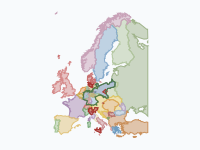
- Deep blue is France itself, including every annexed département; lighter blues and violets are the sister republics and Bonaparte kingdoms (Holland, Italy, Naples, Westphalia, Joseph's Spain, the Duchy of Warsaw); lavender shades are the German states of the Confederation of the Rhine.
- Britain is red, the Habsburg lands are Habsburg yellow, Prussia is dark grey, Russia is green and the Ottoman Empire is sand.
- A pale blue fill marks land under French military occupation for weeks or more (Prussia after Jena, Portugal, the road to Moscow in 1812); a rust-brown fill marks Coalition occupation (northern Italy in 1799, France in 1814 and 1815, Saxony and the Rhineland from 1813).
- The gold dot is Napoleon himself, and the dark blue disk is the field army he commanded, or France's main army when he was not in the field, with its area proportional to the number of men.
- Large markers are battles, treaties and turning points; the small dots are the hundreds of smaller combats, sieges and risings around them. Hover or tap them for details.
- The bar at the top is the running count of military dead, France and its allies in blue against the Coalition in red, with the lighter band showing the range of the estimates.
How the Map Was Made
The borders were researched keyframe by keyframe, region by region, from the treaty texts, the French annexation decrees and the Wikipedia articles on each state and campaign in English, French, German, Italian, Spanish and Polish. The German states, from the patchwork of the Holy Roman Empire to the Confederation of the Rhine, come from the town-by-town ruler data of Cantoni, Mohr and Weigand's Princes and Townspeople (Harvard Dataverse, CC0); elsewhere the borders are built from Natural Earth provinces. Every keyframe was checked against place tests (about 11,000 in all, from Lisbon in 1807 to Moscow in 1812), and every event against its sources in a separate fact-checking pass. The casualty series was modelled campaign by campaign and checked against the full texts of Bodart's Losses of Life in Modern Wars (1916) and Prinzing's Epidemics Resulting from Wars (1916), with the figures of Clodfelter, Urlanis and Houdaille. Peninsular War control and the 1814–1815 occupation of France are drawn at province level and are approximate.
Chronological Timeline
- 19 December 1793 — Toulon retaken; Bonaparte's artillery plan makes his name
- 5 October 1795 — 13 Vendémiaire: Bonaparte crushes a royalist rising in Paris
- 10–15 May 1796 — Battle of Lodi; Bonaparte enters Milan
- 2 February 1797 — Mantua surrenders
- 17 October 1797 — Treaty of Campo Formio: Venice to Austria, Cisalpine Republic recognised
- 21 July 1798 — Battle of the Pyramids
- 1 August 1798 — Nelson destroys the French fleet at the Nile
- 20 May 1799 — Bonaparte lifts the siege of Acre
- 9–10 November 1799 — Coup of 18 Brumaire: Bonaparte becomes First Consul
- 14 June 1800 — Battle of Marengo
- 9 February 1801 — Treaty of Lunéville: France on the Rhine
- 25 March 1802 — Peace of Amiens
- 2 December 1804 — Napoleon crowns himself Emperor
- 20–21 October 1805 — Capitulation of Ulm; Battle of Trafalgar
- 2 December 1805 — Battle of Austerlitz
- 12 July 1806 — Confederation of the Rhine; the Holy Roman Empire ends on 6 August
- 14 October 1806 — Battles of Jena and Auerstedt
- 7–9 July 1807 — Treaties of Tilsit: Westphalia and the Duchy of Warsaw
- 2 May 1808 — Dos de Mayo: Madrid rises against the French
- 19 July 1808 — French capitulation at Bailén
- 5–6 July 1809 — Battle of Wagram
- 14 October 1809 — Treaty of Schönbrunn: the Illyrian Provinces
- 9 July 1810 — Holland annexed to France
- 24 June 1812 — The Grande Armée crosses the Niemen
- 7 September 1812 — Battle of Borodino
- 14 September 1812 — Napoleon enters Moscow
- 26–29 November 1812 — Crossing of the Berezina
- 21 June 1813 — Battle of Vitoria
- 16–19 October 1813 — Battle of Leipzig
- 31 March 1814 — The Allies enter Paris
- 6 April 1814 — Napoleon abdicates; exile on Elba
- 20 March 1815 — Napoleon back in Paris: the Hundred Days
- 18 June 1815 — Battle of Waterloo
- 15 July 1815 — Napoleon surrenders to HMS Bellerophon
- 20 November 1815 — Second Peace of Paris
- 5 May 1821 — Napoleon dies on St Helena
Want to use this map in your own project? You can export it as an animated GIF for presentations and social media, or embed it as a fully interactive widget on your website using the embed code available on the map page.
Explore the full interactive map →Frequently asked questions
- How did Napoleon rise to power?
- His first fame came at the siege of Toulon in December 1793, where his artillery plan took Fort Mulgrave and drove the British fleet out; he was made a brigadier general three days after the city fell. On 5 October 1795 (13 Vendémiaire) he crushed a royalist rising in Paris with grapeshot, which earned him command of the Army of Italy in March 1796. His victories there, from Montenotte and Lodi to the fall of Mantua, ended in the Treaty of Campo Formio in October 1797. After the Egyptian expedition he returned to France and overthrew the Directory in the coup of 18 Brumaire (9–10 November 1799), becoming First Consul. He crowned himself Emperor in Notre-Dame on 2 December 1804.
- How large was Napoleon's empire at its peak?
- At the start of 1811 France had 130 départements, from Hamburg and Lübeck to Rome: Belgium, the left bank of the Rhine, Piedmont, Genoa, Tuscany, the Papal States, Holland and the North Sea coast had all been annexed, and the Illyrian Provinces on the Adriatic belonged to the Empire. Around it lay the Bonaparte kingdoms (Italy, Naples, Westphalia and Joseph's Spain), the Duchy of Warsaw, Switzerland under Napoleon's Act of Mediation and the Confederation of the Rhine, and in 1812 even Austria and Prussia had to send army corps to march with him.
- How many soldiers died in the Napoleonic Wars?
- The map's running count, which covers military deaths from December 1793 to the end of 1815 from all causes (killed, died of wounds, disease, exposure and in captivity), reaches about 1.4 million for France and its allies (range 1.0–1.9 million) and about 1.6 million for the Coalition (range 1.2–2.3 million). The estimates are built per campaign from Gaston Bodart's 1916 study, Friedrich Prinzing's work on epidemics, Clodfelter, Urlanis and Houdaille. Civilian deaths are not in the count; estimates for them run from 0.75 to 3 million.
- What happened to the Grande Armée in Russia in 1812?
- About 422,000 men of the main body crossed the Niemen on 24 June 1812. After the battle of Borodino on 7 September, the bloodiest single day of the wars, Napoleon entered an abandoned Moscow with about 100,000 men on 14 September, and he left it on 19 October. After the crossing of the Berezina at the end of November only about 10,000 men of the main body recrossed the Niemen in mid-December. The map's estimate for the whole campaign is about 330,000 dead on the French side and about 210,000 among the Russian army.
- What did Europe look like after Napoleon?
- The Second Treaty of Paris of 20 November 1815 cut France back to roughly its 1790 borders, imposed an indemnity of 700 million francs and an Allied occupation of the north-east. The Congress of Vienna gave Prussia the Rhineland and half of Saxony, joined Belgium to the Netherlands, gave Lombardy and Venetia to Austria and Genoa to the Kingdom of Sardinia, made most of the Duchy of Warsaw a Polish kingdom under the Russian tsar, and left Kraków a free city. Norway passed from Denmark to a union with Sweden.
- Is there an animated map of Napoleon's rise and fall?
- Yes. Moving Polygons has an animated map, Napoleon's Rise and Fall (1793–1821), that starts at Toulon and ends with his death on St Helena. It shows the borders of every European state at 50 moments, French and Coalition occupation zones, Napoleon's own position and the size of his main army, about 400 events, and a bar that counts the military dead on each side as the years go by. It is free to watch, and you can embed it on your website or export it as an animated GIF.
Text version of the map (timeline, layers and events): Markdown