In 1880 the Netherlands passed a law to protect 'useful animals', bats among them. It was the first Dutch law to protect wild animals, though for the farmer's sake rather than their own. Almost a century and a half later the list of protected species runs into the hundreds, the otter has died out and come back, and wolves raise cubs on the Veluwe again.
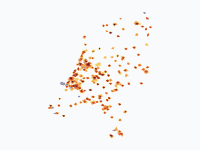
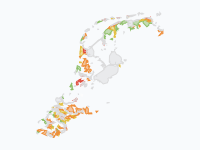
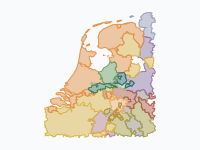
This animated map follows 29 of those animals from 1880 to 2026: where each one lived, when the law began to protect it, and what happened next. Protection and survival turn out to be two different things. Some species vanished decades after they were protected; others returned only when people brought them back.
From Useful Animals to a Species List
The first laws protected animals because they were useful. The act of 1880 covered animals that helped farming and forestry, bats included. The Vogelwet (Birds Act) of 1912 went much further and protected almost all birds: on the map the stork, the spoonbill, the stone-curlew, the ortolan bunting and the tawny pipit turn from grey to colour in that year. A law of 1917 added moles, hedgehogs and frogs.
Protection could also be taken away. Bats lost theirs in 1914, and the mole and the hedgehog in 1963. Some birds stayed outside the law: the raven counted as a harmful bird, and in 1928 the last pair bred near Nijkerk. For mammals the first real step was the ban on hunting otters and badgers in 1942, followed by the end of seal hunting in 1962.
The modern system starts on 20 October 1973, when a species list under the Natuurbeschermingswet came into force. It protected bats again, and with them the hamster, the harbour porpoise, the bottlenose dolphin, all reptiles and amphibians, ten fishes, the stag beetle and the large copper butterfly. The beaver and the sturgeon followed in 1994 under the European Habitats Directive. The Flora- en faunawet of 2002, the Wet natuurbescherming of 2017 and the Omgevingswet of 2024 each replaced the law before it.
The Low Point
The law could not stop the decline of the middle of the 20th century. The sturgeon, once a fish of the Rhine, the Meuse and the IJssel, was declared extinct in 1953. The stone-curlew, a bird of the open dunes between Hoek van Holland and Den Helder, bred for the last time in 1957 at De Zilk, 45 years after it was protected. The harbour porpoise disappeared from the coastal waters around 1960 and the bottlenose dolphin around 1970.
Around 1970 only about ten pairs of white storks were left, in a country where the bird had nested from Zeeland to Groningen. The badger reached its low point around 1980, reduced to scattered groups on the sandy soils and in South Limburg. The otter, protected from hunters since 1942, shrank from most of the country to the fens of Friesland and north-west Overijssel. In 1988 the last one was killed by a car on the A7 motorway at the Langweerder Wielen, and the species was extinct in the Netherlands. The ortolan bunting bred for the last time in 1999 and the tawny pipit in 2003, on the Harskampse Zand on the Veluwe.
The Returns
The turn began at sea. Around 1980 grey seals settled again on the sand flats near Terschelling, and from there they spread over the Wadden Sea, the North Sea coast and the Delta. The harbour seal, hunted until 1962, recovered from the 1980s, and the harbour porpoise came back to the coast in the 1990s.
On land most returns needed help. Ravens were released on the Veluwe around 1970. The first beavers were released in the Biesbosch in 1988, the year the otter died out; the beaver now lives along the rivers in a large part of the country. Otters were released in the Weerribben and De Wieden in 2002, bred hamsters at Sibbe in South Limburg in the same year, and young sturgeons in the Biesbosch in 2023 and at Millingen aan de Rijn in 2024.
Other animals came back on their own. The eagle owl has bred every year in South Limburg since 1997, the first cranes bred in the Fochteloërveen in 2001, the wildcat was first recorded with certainty at Vaalsbroek in 2002, and the first white-tailed eagles bred in the Oostvaardersplassen in 2006. The first wolf settled on the northern Veluwe in 2018, with the first cubs a year later, and by 2022 wolves had settled in Drenthe as well.
The last frame shows the result. In 2026 the Netherlands has 14 wolf packs and about 600 otters, storks nest across the lowlands again, and beavers, badgers and ravens hold large parts of the country. The wolf's success has a legal sequel: in 2026 its status went from 'strictly protected' to 'protected'.
How to Read the Map
The map is in Dutch. Grey means the species lives there but is not protected by law at that moment. Colour means it is protected. When a shape disappears, the species is gone from the Netherlands. The colours go by group: brown, orange and yellow for land mammals, blue for marine mammals, pink, red and purple for birds, green for reptiles and amphibians, blue-green for fish. Species with a wide range are drawn as an outline with a faint fill, local ones as a filled patch. Pins mark events: red for a last breeding record or a last animal, green for a release or a first return. Click a pin for the story, and use the legend to switch species off and on and follow one at a time.
Two groups live almost everywhere, so the whole country takes their colour: bats (protected 1880–1914 and again from 1973) and the mole (protected 1917–1963 and 2002–2017). The bullhead and the bitterling turn grey in 2017, when they were taken off the list because they were no longer considered threatened. The sturgeon and the bottlenose dolphin stay grey to the end: they were already gone when the law protected them.
- Mammals — vleermuizen: bats · mol: mole · otter: otter · das: badger · bever: beaver · wolf: wolf · hamster (korenwolf): European hamster · wilde kat: wildcat
- Marine mammals — bruinvis: harbour porpoise · tuimelaar: bottlenose dolphin · gewone zeehond: harbour seal · grijze zeehond: grey seal
- Birds — ooievaar: white stork · lepelaar: spoonbill · zeearend: white-tailed eagle · kraanvogel: crane · raaf: raven · oehoe: eagle owl · korhoen: black grouse · ortolaan: ortolan bunting · duinpieper: tawny pipit · griel: stone-curlew
- Reptiles and amphibians — adder: adder · boomkikker: tree frog · geelbuikvuurpad: yellow-bellied toad
- Fish — steur: sturgeon · rivierdonderpad: bullhead · bittervoorn: bitterling
- Insects — grote vuurvlinder: large copper
How the Map Was Made
The ranges are schematic. They were modelled by region from atlases and species accounts, not plotted from observations per square kilometre: the national database of such records (NDFF) is not freely available. The years of the laws, the extinctions and the returns come from the sources; the shapes are an approximation, least certain before 1950. The map is a selection of species with a clear story, not all of the hundreds of protected species.
Each range was then cut to the real landscape, using the landscape regions (Fysisch Geografische Regio's) and the Natura 2000 areas published by PDOK. Land animals stop at the coast of that year: the Zuiderzee is sea until 1932, and the polders of Flevoland appear only after they were drained. Animals of heath and forest follow the sandy soils, dune birds the dunes, river fish the Rhine branches, the Meuse and, from 1932, the fresh IJsselmeer. Small populations take the outline of the nature reserve they live in, such as the Weerribben, the Biesbosch, the Fochteloërveen or the Oostvaardersplassen.
A few assumptions are built in. The black grouse is shown as protected from 1980: it was a game bird, and the year the hunt closed could not be established. The raven is shown as unprotected before 1928. Amphibians are shown as protected from 1973; the frog law of 1917–1963 is not drawn separately. Sources include the journals Zoogdier, Het Vogeljaar and Natuurhistorisch Maandblad, the Staatsblad, Sovon, RAVON, Vogelbescherming, the Atlas van de Nederlandse zoogdieren (2016), Wageningen University & Research, BIJ12, Ecomare, ARK and the Province of Limburg; the full list is in the map's description.
Chronological Timeline
- 1880 — Law for 'useful animals': bats protected
- 1912 — Vogelwet: almost all birds protected
- 1914 — Bats lose their protection
- 1917 — Law protecting moles, hedgehogs and frogs
- 1928 — The last pair of ravens breeds near Nijkerk
- 1942 — Hunting of otters and badgers banned
- 1953 — The sturgeon is declared extinct
- 1957 — The stone-curlew breeds for the last time, at De Zilk
- 1962 — Seal hunting closed
- 1963 — Mole and hedgehog lose their protection
- 1970 — About ten pairs of white storks left; ravens released on the Veluwe
- 20 October 1973 — Species list under the Natuurbeschermingswet
- 1980 — Low point of the badger; grey seals back near Terschelling
- 1988 — The last otter is killed on the A7; first beavers released in the Biesbosch
- 1994 — Beaver and sturgeon protected under the Habitats Directive
- 1997 — The eagle owl breeds every year again in South Limburg
- 1999 — The ortolan bunting breeds for the last time
- 2001 — First cranes breed in the Fochteloërveen
- 2002 — Flora- en faunawet; otters released in the Weerribben and De Wieden, hamsters at Sibbe
- 2003 — The tawny pipit breeds for the last time, on the Harskampse Zand
- 2006 — First white-tailed eagles breed in the Oostvaardersplassen
- 2013 — The otter is back in South Holland
- 2017 — Wet natuurbescherming: the mole and three fishes leave the list
- 2018 — The first wolf settles on the northern Veluwe
- 2019 — First wolf cubs on the Veluwe
- 2022 — Wolves settle in Drenthe
- 2024 — The Omgevingswet replaces the nature act; young sturgeons released at Millingen aan de Rijn
- 2026 — 14 wolf packs and about 600 otters; the wolf goes from 'strictly protected' to 'protected'
Watch 29 protected animals lose and regain ground in the interactive map, switch species on and off in the legend, click a pin for the story, or embed the map on your own site. It can also be exported as an animated GIF for lessons and talks.
Explore the full interactive map →Frequently asked questions
- When were animals first protected by law in the Netherlands?
- In 1880, with a law for 'useful animals', which protected bats among others. The Vogelwet (Birds Act) of 1912 protected almost all birds, and a law of 1917 protected moles, hedgehogs and frogs. The first broad species list came on 20 October 1973 under the Natuurbeschermingswet: bats, the hamster, the harbour porpoise, the bottlenose dolphin, all reptiles and amphibians, ten fishes, the stag beetle and the large copper butterfly.
- When did the otter die out in the Netherlands, and when did it come back?
- Otter hunting was banned in 1942, but the species kept declining. The last otter was killed by a car on the A7 motorway at the Langweerder Wielen in 1988, and with it the otter was extinct in the Netherlands. In 2002 otters were released in the Weerribben and De Wieden. From there they spread: back in South Holland (Nieuwkoopse Plassen) in 2013, in the dunes at Meijendel in 2024, and about 600 animals in 2026.
- When did the wolf return to the Netherlands?
- The first wolf settled on the northern Veluwe in 2018, and the first cubs were born there in 2019. By 2022 wolves had also settled in Drenthe. In 2026 the Netherlands has 14 packs. In the same year the wolf's legal status went from 'strictly protected' to 'protected'.
- Which protected animals disappeared from the Netherlands in spite of protection?
- Several birds that the Vogelwet of 1912 protected still disappeared as breeding birds: the stone-curlew bred for the last time in 1957 in the dunes at De Zilk, the ortolan bunting in 1999 and the tawny pipit in 2003 on the Harskampse Zand. The otter died out in 1988, 46 years after otter hunting was banned. The sturgeon and the bottlenose dolphin were already gone when they were protected.
- Which animals lost their legal protection?
- Bats lost their protection in 1914 and got it back in 1973. The mole and the hedgehog lost theirs in 1963; the mole was protected again from 2002 until the Wet natuurbescherming of 2017, which also removed three fishes from the list (bitterling, bullhead and spined loach) because they were no longer considered threatened.
- Is there an animated map of protected animals in the Netherlands?
- Yes. Moving Polygons has a free animated map, in Dutch, of 29 protected animals in the Netherlands from 1880 to 2026. A species is grey where it lives without protection and coloured where the law protects it; pins mark last breeding records, releases and first returns. The ranges are schematic: modelled by region from atlases and species accounts, not plotted from individual observations.
Text version of the map (timeline, layers and events): Markdown