In the spring of 2000, on an army training ground in the far east of Saxony, a pair of wolves that had walked in from Poland raised a litter of pups, the first wolves born in the wild in Germany since the species was exterminated there. Twenty-five years later Germany counted 287 wolf territories, the Netherlands had 14 packs, wolves were breeding in Catalonia for the first time in a century, and the European Union had just lowered the wolf's protection because there were, in the view of many of its governments, too many of them.
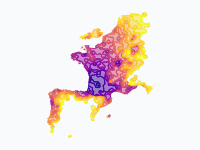
This map follows that return. Every area where wolves now live permanently is coloured by the year they first settled there, from dark navy for the refuges of around 1970 through blue, cyan and green to yellow for 2025/26. Press play and watch the colour spread from Italy, Poland and Finland into countries that had not seen a wolf for a century or more.
A Handful of Refuges
By 1970 the wolf had been shot, trapped and poisoned out of most of western and central Europe. France had had no wolves since 1937. In Italy, Erik Zimen and Luigi Boitani found about a hundred wolves in 1973, in some ten pockets of the Apennines. Scandinavia's wolves were all but gone. The map's first frame shows what remained: north-western Iberia, the central and southern Apennines, the Balkans, the Carpathians, eastern Poland, the Baltic states and a strip along Finland's border with Russia. That layer is hand-drawn and approximate.
Protection, Then an Emptier Countryside
The turn began with the law. In 1971 Italy's agriculture minister took the wolf off the list of vermin and banned hunting and poison baits. In 1979 the Council of Europe's Bern Convention listed the wolf as strictly protected, and in 1992 the EU's Habitats Directive did the same. Poland protected it nationwide in 1998, two years before the first German litter. The wolves came back into a different countryside from the one their ancestors had been driven out of: farming had retreated from many hills and poorer soils, forests had grown, and red deer, roe deer and wild boar had multiplied. By 2014 about a third of mainland Europe had at least one large carnivore species, mostly in landscapes shared with people (Chapron et al. 2014).
The engine of the spread is the young wolf. At one or two years old most wolves leave their pack to look for a mate and an empty territory, some of them hundreds of kilometres away, so watch for lone dots far ahead of the front that a few years later have a ring of new colour around them.
Italian Wolves Climb the Alps
The first big movement on the map is Italian. Through the 1980s the Apennine wolves spread north along the mountains, and in November 1992 two of them were seen in Mercantour National Park, the first wolves in France in more than half a century. In 1995 a wolf crossed into Valais and killed sheep in Val Ferret, and in 2012 a pair on the Calanda massif above Chur raised the first Swiss pack in about 150 years. On the map the western Alps turn blue in the 1990s, while the eastern Alps stay empty for much longer.
The eastern Alps were filled in part by Slavc. In July 2011 the Slovenian biologist Hubert Potočnik fitted a young male of the Slavnik pack with a GPS collar near Kozina. On 19 December Slavc left home, swam the Drava near Klagenfurt and wandered over the Alps for weeks, about 2,000 km in all, until by March 2012 he was in the hills north of Verona. In the Lessinia he met a she-wolf who had come from the western Alps, probably from Piedmont, and the press named the pair Slavc and Giulietta. Two pups were filmed in August 2013 and seven more were born in 2014: the first pack founded by a Dinaric and an Italian wolf, two populations that had been apart for about 150 years.
From Lusatia to the North Sea
The second movement starts in Lusatia. The pair of 2000 settled on the Oberlausitz military training ground, and military land turns up again and again in this story: large, quiet and mostly closed to the public. Germany's count of territories went from 1 in 2000/01 to 57 in 2014/15, 189 in 2019/20 and 289 in 2023/24, then levelled off at 287 in 2024/25. On the map Germany fills in from the east, first in blue and cyan, then in green across the northern plain to Lower Saxony.
Then the wanderers crossed the next borders. In November 2012 a young male was found dead in Thy National Park in Denmark; DNA showed he had been born in a Lusatian pack about 850 km away. A she-wolf joined a male in West Jutland in 2016, and in 2017 they had eight pups, Denmark's first litter in about two centuries. In March 2015 a German wolf spent four days in the Netherlands and turned back. In January 2018, after about two weeks in the Netherlands, a collared she-wolf from Germany called Naya settled in the military areas of Belgian Limburg, the first wolf in Flanders in more than a century. She vanished in May 2019, probably pregnant and, according to the Flemish nature agency, almost certainly killed. In 2018 the first wolf also settled on the Veluwe, where camera traps filmed the first Dutch pups in June 2019. Belgium's first pups, four of them, were born in 2020 to the she-wolf Noëlla and the male August. By 2025 the Netherlands had an estimated 14 packs, and in 2025/26 Denmark had 7 packs, 5 pairs and 2 single territorial wolves. The yellow areas on the last frame, in Drenthe, the Ardennes and Jutland, are the newest of them.
Sheep, a Pony and the 2025 Downgrade
More wolves meant more dead sheep. In 2024 the French authorities recorded about 4,200 wolf attacks on livestock and 11,224 animals killed, injured or missing, with half of the attacks in Provence-Alpes-Côte d'Azur. Switzerland began culling wolves pre-emptively, whole packs included, in December 2023 and shot 92 wolves in the season 2024/25 and 77 more between September 2025 and January 2026, while the number of packs still went up to 40. Spain put all its wolves under strict protection in September 2021, ending hunting north of the Duero, and its parliament reversed that in March 2025.
The most famous victim was a pony. On the night of 1 September 2022 a wolf known as GW950m killed Dolly, the 30-year-old pony of Commission president Ursula von der Leyen, in a paddock at Beinhorn near Hanover. Shooting permits for him ran out or were overturned in court. In December 2023 the Commission proposed lowering the wolf's protection, pointing to the numbers: about 23,000 wolves in 2023 (Russia and Belarus not counted), against about 12,000 around 2011, on a range 35 per cent larger than in 2016. Critics linked the proposal to the pony. The Bern Convention's Standing Committee agreed in December 2024, the change took effect on 7 March 2025, and Directive (EU) 2025/1237 moved the wolf from 'strictly protected' to 'protected' in EU law on 14 July 2025. Member states have until about January 2027 to bring it into national law, and may then cull more freely, as long as their wolf populations stay in favourable condition.
How to Read the Map
The map has 34 frames, from c. 1970 to 2025/26; from 2000/01 there is one frame per monitoring year, which runs from 1 May to 30 April. Each colour is a layer named after the period in which wolves first settled an area, from 'Present c. 1970 (approximate)' in dark navy to 'First present 2025/26' in yellow. Edges are drawn soft on purpose, as a wolf range has no hard border. Areas stay coloured once wolves have settled: they only vanish where a source documents that the wolves left, as in Spain's Sierra de San Pedro (gone by about 2000) and Sierra Morena (gone by the census of 2012–14). Wandering wolves are not drawn; the grey east (Russia, Belarus, Moldova, most of Ukraine) lies outside the surveys. The 23 pins mark laws, first packs and the stories above.
Watch for the blue arc of the western Alps in the 1990s, Lusatia in 2000/01, central Jutland from 2012/13, the Veluwe and Belgian Limburg in 2018/19, Finland filling in from the east, and the 2023/24 additions in France, Switzerland and the Italian Alps.
How the Map Was Made, and Where the Data Stop
The backbone is the 10 x 10 km grid of the European surveys coordinated by the Large Carnivore Initiative for Europe (Chapron et al. 2014 for 2006–2011, LCIE for 2012–2016, Kaczensky et al. 2024 for 2017–2022/23), with the EU's Article 17 report for 2001–2006. Each cell keeps the first year it was permanently occupied. Where countries publish yearly data, those years are used: Germany's DBBW territories (a territory centre plus 8 km), Dutch, Belgian and Danish territories (BIJ12, INBO, Wallonia's Réseau Loup, Aarhus University), Finland's territory outlines from Luke, Austrian packs, French presence cells from the OFB, Swiss records from KORA and Rovbase records for Sweden and Norway. Elsewhere the year between two surveys is estimated, nearest cells first.
Europe counts its wolves very unevenly. Germany counts every territory every year, France estimates its wolves each winter from genetic samples (about 1,080 in 2024/25), and Italy's first national survey, in 2020/21, estimated about 3,500. Spain counted 333 packs in 2021–24 (297 in 2012–14) and Poland found wolves in about 3,000 grid cells in 2023/24, but both publish their maps only as images (Spain's was digitised for this map). So the data stop in different years: 2025/26 for the Netherlands, Belgium, Denmark, Finland and Austria, 2024/25 for Germany (its 2025/26 figures were not out in November 2026) and 2023/24 for France, Spain and the Italian Alps. Sweden, Norway, Poland, Czechia, Slovakia, the Baltic states, the rest of Italy, Portugal and the Balkans stop at the LCIE survey of 2017–2022/23, so from 2023/24 on the map understates the spread there, above all in western Poland.
Chronological Timeline
- 1971 — Italy bans wolf hunting; about a hundred wolves are left in the Apennines
- 1979 — The Bern Convention lists the wolf as strictly protected
- 1983 — A pair breeds in Värmland, the root of today's Scandinavian wolves
- 1992 — EU Habitats Directive; Italian wolves reach Mercantour in France
- 1998 — Poland protects the wolf nationwide
- 2000 — First wolf pups in Germany, in Lusatia
- 2012 — Slavc reaches Verona; first Swiss pack; the Thy wolf in Denmark
- 2016–2017 — First packs in Austria and Denmark
- 2018–2020 — Naya in Belgium; first settled wolves and pups in the Netherlands and Belgium
- 1 September 2022 — GW950m kills Ursula von der Leyen's pony Dolly
- December 2023 — The Commission proposes to lower the wolf's protection
- March and July 2025 — The Bern Convention and EU downgrades take effect
- 2025–2026 — First pack in Catalonia in a century; 14 packs in the Netherlands
Watch the wolf spread from its last refuges across Europe year by year, click the pins for the stories behind the first packs, or embed the map on your own site.
Explore the full interactive map →Another animal on the move across Europe, unwelcome this time: the spread of the Asian hornet since 2004.
Read about the Asian hornet map →Frequently asked questions
- When did wolves come back to Germany?
- In the spring of 2000 a pair that had walked in from Poland raised pups on the Oberlausitz military training ground in the far east of Saxony, in Lusatia: the first wolves born in the wild in Germany since the species was exterminated there. Germany's DBBW counted 1 wolf territory in the monitoring year 2000/01, 57 in 2014/15, 189 in 2019/20, 289 in 2023/24 and 287 in 2024/25.
- How many wolves are there in Europe?
- The European Commission put the number at about 23,000 wolves in 2023, with Russia and Belarus not counted, against about 12,000 around 2011, on a range 35 per cent larger than in 2016. National figures include about 3,500 wolves in Italy (2020/21), 333 packs in Spain (census 2021–24) and about 1,080 wolves in France (winter 2024/25).
- Why did wolves return to western Europe?
- Mainly because people stopped killing them. Italy banned wolf hunting and poison baits in 1971, the Bern Convention of 1979 and the EU Habitats Directive of 1992 made the wolf strictly protected, and Poland protected it nationwide in 1998. The wolves came back into a countryside where farming had retreated from many hills, forests had grown and deer and wild boar had multiplied, and young wolves leave their packs at one or two years old to look for a mate and a territory, some of them hundreds of kilometres away.
- Who was Slavc the wolf?
- Slavc was a young male wolf from Slovenia, fitted with a GPS collar near Kozina in July 2011. He left his pack in December 2011, crossed into Austria and over the Alps, and by March 2012 was in the hills north of Verona, after a journey of about 2,000 km. There he paired with a she-wolf from the western Alps, later called Giulietta, and their first two pups were born in 2013: the first pack founded by a wolf from the Dinaric population and one from the Italian population.
- Is the wolf still a protected species in the EU?
- Yes, but less strictly. The Bern Convention moved the wolf from 'strictly protected' to 'protected' on 7 March 2025, and Directive (EU) 2025/1237 moved it from Annex IV to Annex V of the Habitats Directive on 14 July 2025. Member states have until about January 2027 to bring this into national law and may then manage wolves more flexibly, including by culling, as long as the populations stay in favourable condition.
- Are there wolves in the Netherlands, Belgium and Denmark?
- Yes. The first wolf settled on the Veluwe in the Netherlands in 2018 and the first Dutch pups were born there in 2019; in 2025 the country had an estimated 14 packs. Belgium's first resident wolf, Naya, arrived in Limburg in January 2018, and the first Belgian pups were born in 2020. Denmark's first litter was born in West Jutland in 2017, and in the monitoring year 2025/26 Denmark had 7 packs, 5 pairs and 2 single territorial wolves.
- Is there an animated map of the wolf's return to Europe?
- Yes. Moving Polygons has a free animated map that colours Europe by the year wolves first settled each area, from the last refuges around 1970 to the monitoring year 2025/26, with pins for the laws, the first packs in each country and the famous wanderers. You can watch it, click the pins and embed it on your own website.
Text version of the map (timeline, layers and events): Markdown