A Dot on the Onon
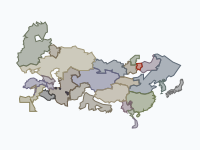
The map opens around 1162 with one small patch of red by the Onon River, where, by tradition at Delüün Boldog, a boy called Temüjin was born to Yesügei of the Borjigin clan. Within eighty years his family's armies had ridden from the Yellow Sea to the Danube, and a khan of his line was still ruling the Crimea in 1783, when Russia annexed it and the map ends.
Most maps of the Mongols stop around 1368, when the empire's last piece fell in China. This one gives the conquests a single section and spends the rest on the two stories around them: the life of the man who started it, and the four centuries in which the heirs of the Golden Horde, the Northern Yuan in Mongolia and the Oirat khans held out against Russia and Qing China. For the conquests campaign by campaign there is a companion map, The Mongol Empire, 1206–1368.
Genghis Khan, 1162–1227
Temüjin's childhood was a hard school even by steppe standards. His father was poisoned, by tradition by Tatars, and the clan abandoned the widow and her children, who lived on roots and fish. According to the Secret History of the Mongols, written a generation after his death, he killed a half-brother in a quarrel, was taken prisoner by a rival clan and escaped, and had his young wife Börte carried off by the Merkits, winning her back with the help of Toghrul of the Keraites and his sworn brother Jamukha. Both helpers became rivals. Temüjin was elected khan of the Mongols around 1189 and then beat the steppe peoples one by one: the Tatars in 1202, Toghrul in 1203, the Naimans and Merkits in 1204. Jamukha was handed over and put to death around 1206.
In the spring of 1206 a kurultai on the Onon proclaimed him Genghis Khan (Chinggis Khan). What made the army that followed different was less its horses, which every steppe people had, than its organisation. He broke up the old tribes into units of ten, a hundred and a thousand under commanders loyal to him, kept a personal guard that also trained his officers, and took in engineers, scribes and interpreters from every people he conquered. Cities that opened their gates were spared; cities that resisted were often destroyed, and word of it travelled ahead of the army. In 1206 his realm covered about 4 million km²; by his death it was about 13.5 million.
Western Xia submitted in 1210, the Jin capital Zhongdu (Beijing) fell in 1215, and after the Khwarazm-shah had one of Genghis Khan's envoys killed, the invasion of 1219–1221 destroyed his empire. Genghis Khan died in August 1227 during the final campaign against Western Xia, most likely in camp near the Liupan mountains (the exact place and cause are uncertain), and his burial place in Mongolia has never been found.
The Heirs and the Split, 1227–1370
Genghis Khan treated the empire as family property. Each son's line had its share (ulus) of people and pasture, and the Great Khan was elected by an assembly of the princes, which was a recipe for rival elections. Under his son Ögedei the armies ended the Jin (1234), took Kiev (1240) and beat the Poles and Hungarians at Legnica and Mohi (1241); under his grandson Möngke they sacked Baghdad (1258). In early 1260, with Aleppo and Damascus taken, the red on the map is at its largest. Möngke had died in 1259, though, and two brothers, Kublai and Ariq Böke, were both elected Great Khan. Their civil war ended in 1264 with four states instead of one: Kublai's Yuan in China and Mongolia, the Golden Horde, the Chagatai Khanate and Hulagu's Ilkhanate in Iran. Together, after Kublai took southern China, they covered about 23.5 million km² in 1294.
In the fourteenth century each khanate came apart in turn: the Ilkhanate in 1335, the Chagatai Khanate in 1347, and in 1368 the Yuan, whose court fled from the Ming to Mongolia and ruled on there as the Northern Yuan. The companion map follows these years in detail; this one moves on.
Timur and the End of the Golden Horde, 1370–1502
Timur, who took power at Balkh on 9 April 1370, was not a descendant of Genghis Khan, and that mattered. He could conquer from Delhi to Ankara, where he captured the Ottoman sultan Bayezid I in 1402, but he could never call himself khan, so he ruled through a puppet khan of the right blood and as a royal son-in-law. His real victim was the Golden Horde. Dmitry Donskoy of Moscow had beaten the warlord Mamai at Kulikovo in 1380, but the khan Tokhtamysh burned Moscow two years later and restored the tribute. Then Tokhtamysh turned on Timur, his former patron, and in 1395 Timur shattered his army on the Terek and sacked the Horde's trade cities, a blow to the trade and the taxes that held it together. Timur died at Otrar in February 1405, marching against Ming China.
Over the next sixty years the gold on the map breaks up. Kazan became a khanate of its own in 1438 and the Crimea under Hacı Giray in 1441, Astrakhan followed in 1466, and in the east the Uzbek khanate and, from about 1465, the Kazakh Khanate of Kerei and Janibek took the steppe. All were ruled by descendants of Genghis Khan's eldest son Jochi. In 1480 Akhmat Khan of the rump Great Horde faced Ivan III's army across the Ugra, waited in vain for Lithuanian help and withdrew; Russian tradition dates the end of the 'Tatar yoke' to that standoff. In June 1502 the Crimean khan Mengli Giray destroyed the Great Horde itself.
Russia and the Khanates, 1502–1783
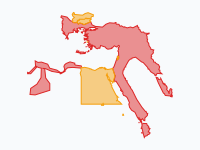
The balance of the steppe had turned. Muscovy and the Ottoman Empire had guns, siege trains and the taxes of settled peasants, and the khanates had cavalry. Ivan IV took Kazan in 1552 after a six-week siege, Astrakhan in 1556 gave Russia the whole Volga, and in 1582 Yermak's Cossacks took the capital of the Khanate of Sibir. The Crimea lasted longest because it had a powerful protector: it had been an Ottoman vassal since 1478. Its horsemen raided Muscovy and Poland-Lithuania for captives, who were sold through the Black Sea ports, and in May 1571 Devlet Giray burned Moscow. Russia answered with fortified lines across the steppe, and in the war of 1768–74 it broke the Ottomans; the peace of 1774 made the khanate independent of the sultan, which left it alone with Russia. Catherine II annexed it in April 1783, ending some 340 years of Giray rule.
Mongolia Between Ming and Qing
In Mongolia the red never quite disappears. A Ming army crushed the Northern Yuan at Buir Lake in 1388, and for half a century the stronger power on the steppe was the Oirats, the western Mongols, whose leader Esen captured a Ming emperor at Tumu in 1449. Dayan Khan reunited the eastern Mongols around 1510. In 1578 his grandson Altan Khan gave the Tibetan lama Sonam Gyatso the title Dalai Lama, which turned the Mongols to Tibetan Buddhism. The end came from the Manchus: in 1635 Ejei Khan surrendered and handed them the Yuan imperial seal, and the next year they proclaimed the Qing dynasty. The Khalkha princes of northern Mongolia, attacked by the Dzungar khan Galdan in 1688, swore allegiance to the Kangxi Emperor at Dolon Nor in 1691, and the red is gone.
The last steppe empire was Oirat. Güshi Khan of the Khoshuts made himself king of Tibet in 1642, the Kalmyks settled on the lower Volga, and the Dzungars under Galdan took Kashgar and Yarkand in 1680, ending the last Chagatayid khanate, and fell on the Kazakhs in the 1720s. The Qing beat Galdan at Jao Modo in 1696 and destroyed the Dzungar Khanate in 1755–57, in campaigns, massacres and smallpox that wiped out most of the Dzungar people. In January 1771 most Kalmyks left the Volga for their old homeland, and Catherine II abolished their khanate.
The map stops in 1783 with the Crimea, the last khanate of Genghis Khan's line that counted in European and Ottoman politics, but much of what it shows is still on today's map. Mongolia declared independence from the Qing in 1911 and, after the revolution of 1921, became the Mongolian People's Republic. The Kalmyks who stayed on the Volga live in Kalmykia, a republic of Russia. The Crimean Tatars, deported by Stalin in 1944, began to return in the late 1980s. And Genghisid khans reigned until the 1820s over the steppe that is now Kazakhstan.
How to Read the Map
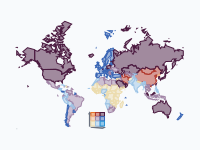
Brick red is the main line: the Mongol Empire, then Kublai's Yuan, the Northern Yuan and the Khalkha Mongols. From 1260 the Golden Horde is gold, the Chagatai Khanate and its heir Moghulistan green and the Ilkhanate blue; Timur's empire is purple. The pieces of the Golden Horde are brown (Kazan, Astrakhan and Sibir), orange (Crimea) and rose (the Uzbek and Kazakh khanates), and the Oirat khanates are teal. A pale fill marks vassals and tributaries, such as the Rus' principalities, Georgia, Tibet and Korea. States that were never Mongol are not drawn, so a conquered kingdom fills with colour and a lost one returns to bare parchment.
Things to watch: from 1206 to 1227 the red spreads from one dot; in 1260 one colour becomes four; in 1335 the blue goes; in 1368 the red leaves China and survives in Mongolia; between 1438 and 1502 the gold breaks into brown, orange and rose; in 1691 the red leaves Mongolia; and in 1771 and 1783 the teal and the orange vanish, leaving the rose of the Kazakh khans. Borders are approximate, because steppe power meant tribute more than fixed lines. The Ilkhanate's successor dynasties and India's Mughals are not drawn. Russian events carry their Old Style dates, as in most histories.
How the Map Was Made
The territories are assembled from Natural Earth provinces and geoBoundaries counties, with the open steppe drawn by hand. The dates, captions and events follow general reference works (the Wikipedia articles on the conquests and the successor khanates, Britannica and the World History Encyclopedia), so this overview is coarser than the 1206–1368 map, which was built from the specialist literature. In November 2026 the names and dates of the two maps were aligned. The borders were tested against 173 city-and-date checks, from the site of Karakorum in 1190 to the Crimea in 1784, and the finished map has ten layers, 73 keyframes, 22 pinned stories and 69 smaller events.
Chronological Timeline
- c. 1162 — Temüjin is born near the Onon River
- 1206 — A kurultai on the Onon proclaims him Genghis Khan
- August 1227 — Death of Genghis Khan
- 1260 — The empire at its largest; then the split into four khanates
- 14 September 1368 — The Ming take Dadu; the Yuan court flees north
- 9 April 1370 — Timur takes power at Balkh
- 1395 — Timur shatters the Golden Horde on the Terek
- 1438–1466 — Kazan, Crimea and Astrakhan break away
- 1449 — The Oirat leader Esen captures a Ming emperor at Tumu
- 1480 — Great Stand on the Ugra
- June 1502 — Crimea destroys the Great Horde
- 2 October 1552 — Ivan IV takes Kazan
- May 1571 — Crimean Tatars burn Moscow
- 1578 — Altan Khan creates the title Dalai Lama
- 1582 — Yermak's Cossacks take the capital of Sibir
- 1635 — Ejei Khan hands the Yuan seal to the Manchus
- 1691 — The Khalkha Mongols submit to the Qing at Dolon Nor
- 1755–1757 — The Qing destroy the Dzungar Khanate
- January 1771 — Kalmyk exodus from the Volga
- April 1783 — Russia annexes the Crimean Khanate
Watch the red break into four colours in 1260, the gold fall apart in the fifteenth century and the last orange patch vanish from the Crimea in 1783, or embed the map on your own site.
Explore the full interactive map →The empire's own century in close-up, with every neighbour it swallowed, the campaign routes and the four khanates: The Mongol Empire, 1206–1368.
Read about the Mongol Empire map →Frequently asked questions
- How did Genghis Khan rise to power?
- Temüjin was born around 1162 near the Onon River. After his father Yesügei was poisoned, the clan abandoned the family and he grew up poor. He was elected khan of the Mongols around 1189 and then beat his steppe rivals one by one: the Tatars in 1202, the Keraites of his former patron Toghrul in 1203, and the Naimans and Merkits in 1204. In 1206 a kurultai on the Onon proclaimed him Genghis Khan, and he reorganised the tribes into decimal army units loyal to him rather than to their chiefs.
- What happened to the Mongols after the Mongol Empire?
- The empire split into four khanates in 1260, and each of them broke up between 1335 and 1502. Their successors lived much longer: the Northern Yuan ruled Mongolia until 1635, the Crimean, Kazan, Astrakhan and Sibir khanates and the Uzbek and Kazakh khans grew out of the Golden Horde, and the Oirat Mongols built the Dzungar Khanate, the last steppe empire, which the Qing destroyed in 1755–57. Russia annexed the Crimean Khanate in 1783.
- What happened to the Golden Horde?
- It was wrecked by Timur, who defeated its khan Tokhtamysh on the Terek in 1395 and sacked its trade cities. In the fifteenth century it broke into the khanates of Kazan (1438), Crimea (1441) and Astrakhan (1466), the Uzbek and Kazakh khanates and a rump, the Great Horde. Russian tradition dates the end of the 'Tatar yoke' to the Great Stand on the Ugra in 1480, and in 1502 the Crimean khan Mengli Giray destroyed the Great Horde.
- Was Timur (Tamerlane) a Mongol khan?
- No. Timur took power in Transoxiana at Balkh on 9 April 1370, but he was not a descendant of Genghis Khan, so he never took the title of khan. He ruled through a puppet khan of Genghis's line and as a royal son-in-law. He conquered from Delhi to Ankara, where he captured the Ottoman sultan in 1402, shattered the Golden Horde in 1395 and died at Otrar in 1405 on a march against Ming China.
- Who were the Dzungars?
- One of the Oirat peoples, the western Mongols. In the seventeenth century the Dzungar Khanate became the last great steppe empire: under Galdan it took Kashgar and Yarkand in 1680 and invaded the Khalkha Mongols in 1688, and in the 1720s it fell on the Kazakhs. The Qing beat Galdan at Jao Modo in 1696 and destroyed the khanate in 1755–57, in campaigns, massacres and smallpox that wiped out most of the Dzungar people.
- What was the last state ruled by descendants of Genghis Khan?
- There is no single answer. The Northern Yuan, the direct continuation of Kublai's line, ended in 1635 when Ejei Khan handed the Yuan imperial seal to the Manchus. The Crimean Khanate of the Giray khans, descendants of Genghis Khan through his son Jochi, lasted about 340 years until Russia annexed it in 1783. Genghisid khans still reigned on the Kazakh steppe until the 1820s.
- Is there an animated map of the rise and fall of the Mongols?
- Yes. Moving Polygons has an animated map, Rise and Fall of the Mongols, 1162–1783, that starts with Temüjin's birth and ends with the annexation of the Crimean Khanate. It shows the united empire, the four khanates, Timur's empire, the Northern Yuan, the Oirat khanates and the later Genghisid states in their own colours, with vassals in a pale fill, in 73 keyframes. A companion map, The Mongol Empire, 1206–1368, shows the conquests in detail. Both are free to watch and to embed.
Text version of the map (timeline, layers and events): Markdown