Four Enemies in One Spring
In the spring of 1672 the Dutch Republic, Europe's greatest trading nation, was attacked by France, England and the prince-bishops of Münster and Cologne at the same time. Within weeks of the French crossing of the Rhine on 12 June, Utrecht, most of Gelderland and Overijssel were in enemy hands and Holland was flooding its own polders to keep Louis XIV's army out; in August a crowd in The Hague lynched Johan de Witt, who had led the Republic for nineteen years, and his brother Cornelis.
The Dutch remember it as the Rampjaar, the disaster year: 'het volk redeloos, de regering radeloos, het land reddeloos', the people irrational, the government desperate, the country beyond saving. It also brought a 21-year-old prince of Orange, William III, to power, and he spent the rest of his life opposing the king who had nearly destroyed his country. The map follows both men from 1650 to 1715, along the arc of Luc Panhuysen's Oranje tegen de Zonnekoning (2016).
A Prince Without an Office, 1650–1672
William was born in The Hague on 14 November 1650, eight days after his father William II died of smallpox. William II had marched on Amsterdam that summer, and the regents of Holland made sure it would not happen again: Holland left the stadholderate empty for twenty-two years, led from 1653 by its Grand Pensionary Johan de Witt, and the Perpetual Edict of 1667 abolished it.
Louis XIV, twelve years older, took the government of France into his own hands in 1661. In 1667 he claimed much of the Spanish Netherlands for his Spanish wife and took Lille and a string of Flemish towns. De Witt did not want France as a neighbour and joined England and Sweden in the Triple Alliance; at Aix-la-Chapelle in May 1668 Louis made peace and kept Lille. He did not forgive the Dutch. At Dover in 1670 he bought Charles II's alliance, Sweden took French subsidies, and the Elector of Cologne, who was also prince-bishop of Liège, opened a road for the French army along the Meuse.
1672: The Rhine, the Water and the Mob
England attacked the Dutch Smyrna convoy in March and declared war at the end of the month; France followed on 6 April, opening the Franco-Dutch War, and Münster and Cologne on 18 May. About 120,000 French troops under Condé and Turenne, with Louis at their head, took the Dutch-garrisoned fortresses on the lower Rhine almost without resistance and on 12 June crossed the Rhine at the Tolhuis near Lobith, behind the Dutch line on the IJssel. William, captain-general since February, fell back through Utrecht into Holland. Utrecht opened its gates, Arnhem, Zutphen and Naarden fell, Nijmegen followed on 9 July, and the armies of Münster and Cologne took Deventer, Zwolle and Kampen, overran Overijssel and Drenthe and laid siege to Groningen on 21 July.
What saved Holland was water. The inundations were ordered on 8 June, and from 22 June sluices and dikes were opened along a line from Muiden on the Zuiderzee to Gorinchem, flooding the polders with water too shallow for boats and too deep to march through. By July the water lay between the French in Utrecht and the cities of Holland. Louis's peace terms, down to a yearly Dutch embassy bringing him a medal praising his magnanimity, were meant to humiliate; the States refused them.
Behind the water the regents fell. Johan de Witt was stabbed on 21 June and survived; in Dordrecht and other towns crowds and civic guards forced the magistrates to revoke the Perpetual Edict, and on 4 July Holland made William stadholder. Cornelis de Witt, arrested on a charge of plotting to murder the prince, was tortured and sentenced to banishment. On 20 August, when Johan came to the Gevangenpoort to collect him, members of the Hague civic guard and a crowd killed both brothers; their bodies were hung by the feet from the gallows on the Groene Zoodje and mutilated. Nobody was ever tried. Whether William had a hand in it has never been settled, but he left the ringleaders alone and some of them did well in his service.
Then the war turned. Groningen held, and the bishop of Münster lifted the siege on 27 August (the city still celebrates every 28 August). At the end of December the floods froze, and Luxembourg's troops crossed the ice and burned Bodegraven and Zwammerdam before a thaw drove them back. In 1673 Louis took Maastricht, but De Ruyter's victory off Kijkduin ended the plans for an English landing, the Emperor and Spain joined the Republic, and in November William and the imperial army took Bonn, cutting the French supply line down the Rhine. The French left Utrecht that month, England made peace in February 1674, Münster and Cologne in the spring, and only Maastricht and Grave stayed French.
From Nijmegen to Torbay, 1674–1688
From 1672 on William believed that Louis was after a universal monarchy and that only a coalition could hold France back, and he spent his life building one. In the field he won few battles: a bloody draw against Condé at Seneffe in 1674, defeat at Cassel in 1677. Sweden, paid by France, invaded Brandenburg and was beaten by the Great Elector at Fehrbellin in June 1675. The Peace of Nijmegen of August 1678 cost the Republic nothing; Louis even gave Maastricht back. Spain paid instead, with Franche-Comté, Valenciennes, Cambrai, Ypres and more. William had married his cousin Mary Stuart, daughter of the Catholic Duke of York, in November 1677.
Louis spent the peace taking more: the 'reunions' along his eastern border, Strasbourg in September 1681, William's principality of Orange in 1682, Luxembourg in 1684. In October 1685 he revoked the Edict of Nantes; tens of thousands of Huguenots fled to the Republic, and Dutch and English opinion turned against him.
In 1688 the two quarrels met. James II, the Catholic king of England, had a son in June, and seven English grandees invited William to intervene. On 27 September Louis's army crossed into the Rhineland to besiege Philippsburg, and with the French committed in Germany the Dutch let William use their fleet and army. He sailed with more than 400 ships and some 15,000 soldiers, and the easterly wind that kept the English fleet in the Thames carried him to Brixham on Torbay on 15 November (5 November Old Style). James's army melted away, James fled to France, and in February 1689 Parliament offered the crown to William and Mary jointly.
King of Three Kingdoms, 1689–1697
William and Mary were crowned on 21 April 1689 (11 April Old Style), the day Scotland proclaimed them. Ireland had to be conquered: James landed there with French support, Derry held out against him for 105 days, and William beat him at the Boyne on 11 July 1690 (1 July Old Style); the Treaty of Limerick ended the war in October 1691. On the continent the Nine Years' War was fought over the old frontier fortresses: Louis took Mons and Namur, William lost at Steenkerque and Landen, and at La Hogue in 1692 the Anglo-Dutch fleet ended French invasion plans. Mary died in January 1695; that September William retook Namur, his greatest success in the field. At Ryswick in 1697, with both sides exhausted, Louis recognised William as king, gave back Lorraine and Luxembourg, and kept Strasbourg.
The Spanish Succession, 1700–1715
Carlos II, the last Habsburg king of Spain, died on 1 November 1700 and left his crowns to Louis's grandson, Philip of Anjou, and Louis accepted the will. In February 1701 French troops took over the barrier fortresses of the Spanish Netherlands from their Dutch garrisons; in September, as James II died in exile, Louis recognised his son as king of England, and English opinion swung behind William's renewed Grand Alliance. William did not live to fight the war. He died at Kensington on 19 March 1702 (8 March Old Style), after his horse stumbled on a molehill and threw him.
His alliance fought the War of the Spanish Succession without him: Blenheim in 1704, Ramillies in 1706 (the map then shows most of the Spanish Netherlands under an Anglo-Dutch condominium), Lille in 1708, Malplaquet in 1709. The Peace of Utrecht of April 1713 let Philip V keep Spain if he renounced the French throne, gave the Southern Netherlands to Austria with a Dutch barrier, and gave Orange to France for good. Louis died at Versailles on 1 September 1715, thirteen years after his rival. From the Rampjaar to Utrecht, their duel had lasted forty-one years.
How to Read the Map
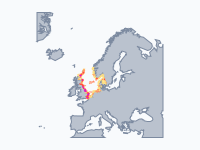
France is dark blue as it stood in 1661, Louis's lasting conquests a lighter blue, and land he took but gave back pale blue, drawn over the occupied country. The Dutch Republic is orange; Münster is brown and Cologne plum, and the light blue band in Holland is the Water Line, white while frozen in 1672–73. Spain and its Netherlands are gold, lilac under Philip V from 1701; the Southern Netherlands turn the pale yellow of the Austrian Habsburgs in 1713. England is red, Scotland grey-blue and Ireland green, all three red-orange while William is king (1689–1702), with dark green for Jacobite Ireland. Greyish blue marks Lorraine and Orange under French occupation; the grey disc is the Brandenburg army. Click a large pin to read it; small dots show smaller events on hover. Dates are New Style, with Old Style added for English events.
The map opens on the Low Countries and the Rhine and is cropped at its edges: Spain is drawn only down to 40° N, Sweden and Norway only up to about 60° N, and Finland and Sweden's Baltic provinces are left out.
How the Map Was Made
The story follows Luc Panhuysen's Oranje tegen de Zonnekoning: De strijd van Willem III en Lodewijk XIV om Europa (Atlas Contact, 2016); the other sources are Jonathan Israel's The Dutch Republic (1995) and John Lynn's The Wars of Louis XIV (1999). The borders are approximate, built from Natural Earth's modern provinces with hand-drawn historical cuts; small enclaves are left out and the Zuiderzee is left as water. The occupation of 1672–74 is drawn as broad areas, so isolated garrisons such as Grave, French until October 1674, do not show. The map has 67 keyframes from 14 November 1650 to 1 September 1715, 41 event pins and 86 smaller events.
Chronological Timeline
- 1650 — William III born, eight days after his father's death
- 1653 — Johan de Witt becomes Grand Pensionary of Holland
- 1672 — The Rampjaar; the Water Line; the De Witt brothers murdered
- 1673 — Maastricht falls; Bonn taken; the French leave Utrecht
- 1677 — William marries Mary Stuart
- 1678 — Peace of Nijmegen
- 1685 — Revocation of the Edict of Nantes
- 1688 — Louis besieges Philippsburg; William lands at Torbay
- 1690 — Battle of the Boyne
- 1697 — Peace of Ryswick
- 1700 — Carlos II dies; Philip V king of Spain
- 1702 — Death of William III
- 1713 — Peace of Utrecht
- 1715 — Death of Louis XIV
Stop the map in July 1672, with the French in Utrecht and the Water Line filling, then play on into 1689 as the British Isles turn red-orange under William.
Explore the full interactive map →How the Republic that Louis attacked in 1672 came to exist: the revolt and the sieges that drew its borders, 1568–1648.
Read about the Eighty Years' War →Frequently asked questions
- What was the Rampjaar of 1672?
- Rampjaar, 'disaster year', is the Dutch name for 1672, when France, England and the prince-bishops of Münster and Cologne attacked the Dutch Republic at the same time. After the French crossed the Rhine at the Tolhuis near Lobith on 12 June, Utrecht, most of Gelderland and Overijssel were overrun within weeks, Holland flooded its Water Line to keep the French out, William III of Orange was made stadholder of Holland on 4 July, and on 20 August Johan and Cornelis de Witt were lynched in The Hague.
- What was the Dutch Water Line of 1672?
- A belt of deliberately flooded polders from Muiden on the Zuiderzee to Gorinchem. The flooding was ordered on 8 June 1672 and the sluices and dikes were opened from 22 June, filling the land with water too shallow for boats and too deep to march through. By July it lay between the French in Utrecht and the cities of Holland. Only when it froze, at the end of December 1672, did Luxembourg's troops cross it, and they burned Bodegraven and Zwammerdam before a thaw drove them back.
- Why were Johan and Cornelis de Witt murdered?
- They were blamed for the collapse of 1672. Johan had led Holland as Grand Pensionary since 1653, the years in which it kept the stadholderate empty; his brother Cornelis was arrested on a charge of plotting to murder William III, tortured and sentenced to banishment. On 20 August 1672, when Johan came to the Gevangenpoort in The Hague to collect him, members of the Hague civic guard and a crowd killed both brothers, and their bodies were hung from the gallows and mutilated. Nobody was ever tried, and William left the ringleaders alone.
- How did William III become king of England?
- By invading it. In 1688 seven English grandees invited him to intervene against the Catholic James II, the father of his wife Mary. When Louis XIV sent his army against Philippsburg on the Rhine at the end of September, the Dutch let William use their fleet and army; he sailed with more than 400 ships and some 15,000 soldiers and landed at Brixham on Torbay on 15 November 1688 (5 November Old Style). James fled to France, and in February 1689 Parliament offered the crown to William and Mary jointly.
- Why did William III and Louis XIV fight for so long?
- Because of 1672. From then on William believed Louis was after a universal monarchy and that only a coalition could hold France back, and Louis kept taking more: the reunions on his eastern border, Strasbourg in 1681, William's principality of Orange in 1682, Luxembourg in 1684. They fought the Franco-Dutch War of 1672–1678 and the Nine Years' War of 1688–1697, and after William's death in 1702 his alliance fought the War of the Spanish Succession until the Peace of Utrecht in 1713.
- Who won, William III or Louis XIV?
- Neither outright. Louis kept most of what he took by 1678, Franche-Comté included, and his grandson kept Spain at Utrecht in 1713. But he never destroyed the Republic, which lost nothing at Nijmegen in 1678; he had to recognise William as king at Ryswick in 1697; and at Utrecht the Southern Netherlands went to Austria with a Dutch barrier while Philip V renounced the French throne. Louis outlived his rival by thirteen years and died in 1715.
- Is there an animated map of the Rampjaar and the wars of William III and Louis XIV?
- Yes. Moving Polygons has a free animated map, Orange versus the Sun King, that follows the two men from William's birth in 1650 to Louis's death in 1715 in 67 dated steps: France and its conquests in blues, the Dutch Republic in orange, the occupation of 1672–74 and the flooded Water Line, the Stuart kingdoms under William in red-orange and Bourbon Spain in lilac, with 41 event pins and 86 smaller events. You can watch it, embed it on your own website or export it as an animated GIF.
Text version of the map (timeline, layers and events): Markdown