A Kindergarten Full of Tyres
In September 1990, just after the summer holidays, a small black mosquito with white stripes turned up at a kindergarten in Genoa. In the playground lay a heap of discarded tyres, and the rainwater inside them was full of the larvae of Aedes albopictus, the Asian tiger mosquito. A year later it was breeding around Padua, and from there it took Italy, then the Mediterranean coast, then much of Europe. In 2025 it gave Europe its worst year yet for chikungunya, with 788 local cases in France and 384 in Italy.
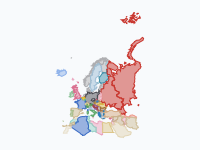
This map follows that journey region by region, from the first European record in Albania in 1979 to 546 regions in 34 countries in 2026. A region turns amber in the year the mosquito is first found there and red once it is established; blue pins mark the outbreaks of dengue and chikungunya that local tiger mosquitoes passed on.
Eggs That Travel in Tyres
The tiger mosquito comes from the forests of South-East Asia, where it breeds in tree holes and bamboo stumps. A used tyre is an excellent tree hole: it holds rainwater, stays dark and warm, and sits in a stack of thousands. The female lays her eggs on the wall of the container just above the water line, and the eggs can lie dry for months before rain floods them and they hatch. Strains from colder places also lay eggs that wait out the winter. That makes the mosquito one of the most efficient stowaways in the world. It was found in Houston in 1985, in used tyres shipped from Asia, and its arrival in Europe followed the same trade.
The first European population was in Albania. In August to October 1979 the mosquito was found at a number of widely separated sites there, breeding mainly in used tyres; it had probably come from China in the mid-1970s, when Albania was China's closest ally in Europe, and the find became widely known only with a paper by Adhami and Reiter in 1998. On the map most of Albania is drawn from 1979, Durrës and Lezhë in red and most other districts in pale red because no record dates them; Tirana and Shkodër follow with dated records in 2011 and 2012. Italy's mosquitoes probably came from elsewhere: the Italian researchers who studied the first infestations concluded that they most likely arrived with used tyres imported from the United States, and the Padua infestation was put down to loads of tyres from Atlanta. Through the 1990s Italy was the centre of the European spread. Watch the Po valley and Tuscany fill up between 1991 and 1996, and the first amber in Rome in 1992.
Along the Motorways
Once it lived in Italy and on the French Riviera, the mosquito no longer needed ships. Adult females fly into a car or lorry to bite the driver and get out hundreds of kilometres away, and researchers in Spain have found adult tiger mosquitoes travelling inside cars (Eritja and colleagues, 2017). The map's first-record pins read like a road atlas. In Switzerland the first find, in the summer of 2003, was at the Coldrerio service area on the A2 motorway in Ticino, a few kilometres from the Italian border; Ticino had an established population from 2007. Germany's first eggs were found in September 2007 at a service area on the A5 near Weil am Rhein, where the motorway from Basel enters the country. Serbia's first was caught in an egg trap at the Batrovci border crossing in 2009, Czechia's at road border crossings near Břeclav in 2012, Armenia's at Bagratashen on the border with Georgia in 2016, and Britain's in 2016 at a lorry park near Folkestone, close to the Channel Tunnel terminal.
On the map this shows as a jump-and-fill pattern. A single amber region appears far ahead of the front on a transport route, and a few years later the red catches up with it. France is the clearest case. After two short-lived finds at tyre depots in Orne and Vienne in 1999, the first population that lasted was at Menton in 2004. From there the red runs west along the coast and north up the Rhône valley, and by the late 2010s it covers most of the south and reaches Paris (2018). Spain's story begins at Sant Cugat del Vallès near Barcelona in 2004 and runs down the Mediterranean coast. Not every arrival takes: the Netherlands has had the mosquito brought in again and again since 2005, first in shipments of lucky bamboo and later along roads and at tyre yards, and every Dutch region on the map is still amber.
Why It Matters Now: Dengue and Chikungunya
The tiger mosquito can carry the viruses of dengue and chikungunya. Neither is native to Europe, but every summer travellers bring them back, and if a local tiger mosquito bites one of them, it can infect the neighbours. In the summer of 2007 a traveller returning from India brought chikungunya to Castiglione di Cervia and Castiglione di Ravenna in Emilia-Romagna: about 330 people fell ill, 217 of them confirmed in the laboratory. It was the first chikungunya outbreak in Europe, and it is the first blue pin on the map. In 2010 dengue was caught in Europe for the first time in decades: by two people in Nice who had not travelled, and by a German visitor to the Pelješac peninsula in Croatia, after which more infections were found among the residents. In 2017 chikungunya broke out at Anzio, in Rome and at Guardavalle Marina in Calabria, with 270 confirmed cases. In 2024 the coastal town of Fano had 199 dengue cases (138 confirmed, 61 probable) between August and late October.
Then came 2025. By 31 December ECDC counted 788 locally acquired chikungunya cases in France and 384 in Italy, a record, with one of the largest French clusters (about 100 cases) at Bergerac in the Dordogne. The map shows why the numbers are rising. Each red region is a place where a traveller's virus can find a mosquito, and the red now covers most of France, Italy, the Balkans and Greece. Warmer summers lengthen the season in which the mosquito is active and the virus can multiply inside it.
How to Read the Map
Each region is a NUTS3 unit (a French département, a Spanish or Italian province, a German district, a Swiss canton) or, where there is no NUTS, as in Bosnia, Ukraine, Russia and the Caucasus, an admin-1 region. Amber means detected but not, or not yet, established, and it includes finds that were wiped out: Vrasene in Belgium in 2000, the Dutch import sites and the eggs in Kent stay amber to the end. Red means an established population that breeds and survives the winter; a region turns from amber to red in the year a source dates the establishment. Pale red means established, but no dated first record was found, so the region appears in the year of the earliest map or list that shows it. Brown pins and dots mark the first record in each country; click them for the place and the source. Blue pins mark the local outbreaks. There is one keyframe per mosquito season, dated 1 July: 1979, and every year from 1990 to 2026 except 1998, when nothing changed.
A region is coloured as a whole even when only one town is affected, so large regions weigh more than they should: one find at Sochi colours all of Krasnodar Krai. And the map shows records, which depend on who went looking. France publishes an official list of colonised départements every year, Spain has a dataset by municipality to 2024, and Switzerland, Austria, Germany, Belgium and the Netherlands run trap networks at motorways and import sites. Italy stopped dating provinces once the mosquito was everywhere, so after the mid-1990s most Italian provinces are dated only by the earliest map or list that shows them. The 37 provinces that turn pale red together in 2007 are the provinces on ECDC's first European map of January 2008, not a sudden jump. Many first records in Bulgaria and Hungary are citizen-science photos from 2019 to 2021, so those years partly mark when people started sending in photos. The years 2024 to 2026 are incomplete: the Spanish dataset ends in 2024, France publishes each year's status the following January and the last frame is 1 July 2026. The fall in new regions at the end is reporting lag, not a slowdown.
How the Map Was Made
The map is built from about 610 dated records in national and peer-reviewed sources: the French health ministry's maps and regional health agencies, the Spanish InVaMoSp dataset (Eritja and colleagues), the Portuguese REVIVE reports, Swiss, Austrian, German, Belgian and Dutch monitoring reports, the Italian literature from Sabatini (1990) and Dalla Pozza (1994) to Romi (2001) and the Italian National Institute of Health's maps of published records (Busani and colleagues, 2012), Giatropoulos and colleagues (2012) for Greece, Garamszegi and colleagues (2023) for Hungary, and national papers for the Balkans, Türkiye and the Black Sea. For about 115 regions without a dated record, the year comes from the earliest of ECDC's TigerMaps map of January 2008, the VectorNet and ECDC maps of 2014 to 2023 and the VectorNet status data on GBIF. Everything was checked against the ECDC/EFSA VectorNet map of August 2023 and ECDC's counts of April 2026. The outbreak figures come from ECDC's data on local transmission and from Eurosurveillance. The boundaries are Eurostat's NUTS 2021 regions at 1:3 million (for the United Kingdom, NUTS 2016), with Natural Earth admin-1 regions fitted to the same country borders elsewhere. The data run to November 2026.
Chronological Timeline
- 1979 — First European records, at several sites in Albania, mostly in used tyres
- September 1990 — Found at a kindergarten in Genoa where old tyres were kept
- 1991 — Established around Padua
- 1999 — Two French tyre depots (the populations did not last)
- 2003 — Coldrerio service area on the A2 in Ticino; Thesprotia and Corfu in Greece
- 2004 — Menton on the French Riviera, Sant Cugat near Barcelona, Zagreb
- 2005 — First Dutch find, at an importer of lucky bamboo
- 2007 — Eggs at a service area on the A5 in Germany; chikungunya in Emilia-Romagna (about 330 cases)
- 2010 — First local dengue cases, in Nice and on the Pelješac peninsula
- 2016 — Eggs at a lorry park near Folkestone
- 2017 — Chikungunya at Anzio, Rome and Guardavalle Marina (270 confirmed cases)
- 2024 — Dengue at Fano (199 cases)
- 2025 — Record year for local chikungunya: 788 cases in France, 384 in Italy
Watch the tiger mosquito spread region by region, click a pin for the source of each first record and the figures of each outbreak, or embed the map on your own site.
Explore the full interactive map →Another Asian stowaway that spread through Europe in shipped goods: the yellow-legged hornet, from one queen in south-west France in 2004.
Read about the Asian hornet map →Frequently asked questions
- When did the Asian tiger mosquito arrive in Europe?
- The first European records are from Albania, where it was found at several widely separated sites between August and October 1979, breeding mainly in used tyres; it had probably come from China in the mid-1970s. Western Europe's story starts in September 1990, when it was found at a kindergarten in Genoa where old tyres were kept, and in 1991 it was established around Padua, probably with used tyres imported from the United States.
- How does the tiger mosquito spread so fast in Europe?
- By hitching rides. The female lays her eggs on the inside wall of a container just above the water, and the eggs survive drying out for months, so a stack of used tyres or a shipment of lucky bamboo can carry them across the world. Over land, adult mosquitoes travel in cars and lorries: many first finds were at motorway service areas, lorry parks and border crossings, such as the A2 in Ticino in 2003, the A5 near Weil am Rhein in 2007 and a lorry park near Folkestone in 2016.
- Which European countries have the Asian tiger mosquito?
- By 2026 the map shows established populations in 28 countries, from Spain, Portugal and France to Italy, the Balkans, Greece, Bulgaria, Romania, Hungary, Germany, Belgium, Luxembourg, Switzerland, Austria, Malta, Cyprus, Moldova, Ukraine, southern Russia and Armenia. In the Netherlands, Czechia, the United Kingdom, Türkiye, Georgia and Liechtenstein it has been found but is not shown as established.
- Have there been dengue and chikungunya outbreaks in Europe?
- Yes, all spread by tiger mosquitoes that had bitten an infected traveller. Emilia-Romagna had about 330 chikungunya cases in 2007, 217 of them confirmed in the laboratory. Nice and the Pelješac peninsula in Croatia had the first local dengue cases in 2010. Anzio, Rome and Guardavalle Marina had 270 confirmed chikungunya cases in 2017, Fano had 199 dengue cases in 2024, and 2025 was a record year for local chikungunya, with 788 cases in France and 384 in Italy (ECDC, to 31 December 2025).
- Is the map's year the year the mosquito arrived?
- It is the year of the first documented record, which depends on someone looking. France publishes its list of colonised départements every year, so French dates are close to the truth. For about 115 regions, most of them Italian provinces, no dated record was found, so they appear in the year of the earliest map or list that shows them, such as ECDC's first map of January 2008; the mosquito reached them that year or earlier. The years 2024 to 2026 are incomplete because reports arrive late.
- Is there an animated map of the Asian tiger mosquito's spread in Europe?
- Yes. Moving Polygons has a free animated map that colours every region of Europe (NUTS3, or admin-1 where there is no NUTS) from the year the tiger mosquito was first recorded there, from 1979 to 2026: amber when detected, red once established, pale red when only an early map or list dates it. Brown pins and dots mark each country's first record and blue pins the local dengue and chikungunya outbreaks. You can watch it and embed it on your own website.
Text version of the map (timeline, layers and events): Markdown