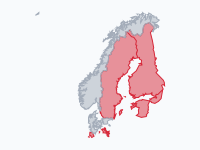
In 1900 the average Dane drank about 7 litres of pure alcohol a year as akvavit and other spirits, against just over 4 litres as beer. Twenty years later beer was well ahead, and since about 2010 Denmark has bought more of its alcohol as wine than as beer, which by the plain arithmetic of this map puts it in the wine belt, a club that once started somewhere south of the Alps.
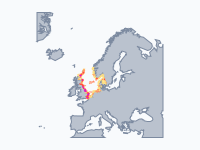
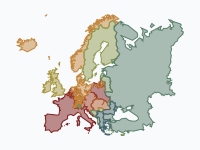
The map colours every country of today's Europe by the drink with the largest share of the pure alcohol drunk there: red for wine, yellow for beer, blue for spirits, from 1800 to the latest WHO figures (2022–2024). In 1800 that gives the three belts of the textbooks, wine in the south, beer in a band from Britain to Bohemia and spirits in the north and east. In the last frame beer leads in 23 of the 43 countries, and the belts have run into each other.
Three Belts Around 1800
The belts follow farming more than taste. In 1800 the wine countries were the ones that grew wine, from Portugal and Spain to Greece and the Danube lands of Hungary, Romania and Moldova. Beer belonged to the barley lands of Britain, Belgium, Germany, Bohemia and Austria (Austria with an asterisk: Vienna grew vines, the Alpine west brewed). North and east of them people distilled grain and, more and more, potatoes: akvavit in Scandinavia, genever in the Netherlands, vodka from Poland to Russia, rakija in the Balkans. These first colours are informed estimates, because national statistics begin only around 1890 in most of western Europe and much later in the east.
The middle of the nineteenth century was the high tide of spirits. In Prussia around 1840 about 7.9 of the 8.8 litres of pure alcohol drunk per head came from Branntwein, mostly cheap potato schnapps; Bavaria and Württemberg stayed beer lands but were outnumbered, so the map turns Germany blue in 1850. Lager won it back: pale lager, first brewed in Pilsen in 1842, spread across Germany, a heavy spirits tax followed in 1887, and in 1888–92 beer had 49 per cent of German alcohol against 44 for spirits. The Netherlands kept its genever much longer, with about 4.1 litres of pure alcohol a head as spirits and 1.4 as beer in 1900; only around 1960 did beer draw level.
Ireland went from whiskey to stout. Father Mathew's temperance crusade, launched in Cork in 1838, cut legal whiskey sales sharply, and porter and stout took the place of spirits later in the century. The map dates the switch to 1880; the figures suggest beer clearly passed spirits only between about 1885 and 1900.
Denmark: Akvavit, Beer, Then Wine
No country on the map travels further. Around 1900 Denmark was among the heaviest spirits drinkers in Europe, with 7.1 litres of pure alcohol a head as spirits against 4.3 as beer. During the First World War spirits collapsed, from 5.7 litres in 1910 to 2.0 in 1920, while beer held at about 3.7, and the steep akvavit tax of 1917 kept them down. For the next half century the country of Carlsberg and Tuborg was the purest beer country on the map: in the early 1960s beer supplied 77 per cent of all the alcohol Danes drank.
Then wine crept in. Its share rose from 8 per cent in the early 1960s to 37 per cent around 2000, and in the WHO averages for 2008–2012 wine (45 per cent) passed beer (39). In 2022–2024 it was 43 against 37. Danes still drink plenty of beer, only far less of it: about 7.5 litres of pure alcohol a head in the 1970s and 1980s, 3.3 in 2023. Wine rose while beer fell, which is how a country can turn the colour of Portugal without anyone planting a vine.
The North Turns to Beer
Sweden drank spirits for longer. Its sales statistics, kept since 1861 and published by the Swedish alcohol council CAN, show 6.1 litres of pure alcohol per adult as spirits in 1880 against 1.0 as beer. Alcohol was rationed under the Bratt system from 1917 to 1955, and spirits still led. Medium-strength beer in grocery shops, the mellanöl of 1965–1977, brought beer close (2.8 litres against 3.3 around 1970), but by Swedish figures beer passed spirits only in 1989, and wine passed beer in 2002. In 2022–2024 wine had 45 per cent of Swedish alcohol, beer 37.
Norway took a detour through prohibition. Spirits were banned from 1916 to 1927 while beer stayed legal, so the recorded figures for 1920 put beer in front and the map shows Norway yellow for one frame. By 1950 spirits were back on top, 1.61 litres per adult against 1.06 for beer. Beer passed spirits for good in 1968 (1.98 litres against 1.95, Statistics Norway), and Norway has been yellow ever since; wine is closing in, at 38 per cent against 41 for beer in 2022–2024, but has not got there.
Finland was dry from 1919 to 1932 and drank mostly spirits before and after. The turn came with the alcohol law of 1969, which let more than 17,000 grocery shops sell medium-strength beer and allowed state liquor shops in the countryside; total consumption rose by nearly half within a year, and in the WHO averages for 1968–1972 beer already had 43 per cent against 20 for spirits. Iceland banned all alcohol in 1915 and let wine (to keep Spain buying its fish) and spirits back in stages, but beer stronger than 2.25 per cent stayed illegal until 1 March 1989, still marked as Beer Day. Beer had 30 per cent of Icelandic alcohol in 1988–1992, drew level with spirits in the mid-1990s and had 49 per cent around 2000.
The East Follows, Mostly
Poland was a vodka country for as long as there are figures: spirits supplied 59 per cent of recorded alcohol in the early 1960s and 67 per cent around 1980. In the 1990s beer took over, and PARPA, the Polish state agency for alcohol problems, dates the moment beer passed vodka to 1999; in 2022–2024 beer had 52 per cent and spirits 40. Croatia, Bosnia and Herzegovina and Romania turned to beer between 2000 and 2005, Serbia and Montenegro probably decades earlier, though there are no Serbian figures before 2005.
The East also shows that the drift is not all one way. Hungary went from wine to spirits around 1980 and to beer in 1990, and in 2022–2024 spirits were a point ahead again (38 against 37). Slovakia drank mostly beer as part of Czechoslovakia, 61 per cent in the early 1960s, and turned to spirits after 2000: 51 per cent in 2022–2024, against 32 for beer. Estonia, Latvia and Lithuania swing between beer and spirits by a few points, and in the latest figures all three lean to spirits.
Russia is the closest call on the map. Spirits had 77 per cent of recorded alcohol in the mid-1990s, after state campaigns against vodka that never lasted, from Nicholas II's ban of 1914 to Gorbachev's of 1985–1988. Then beer rose so fast that in 2018–2022 it had 43 per cent against 41 for spirits; in 2023–2024 spirits were narrowly ahead again, 44 against 42. Under the map's rule a lead of less than three points does not change a colour, so Russia, with Ukraine and Belarus, stays blue for the whole period.
The Wine Belt Thins Out
The south changed more quietly. Phylloxera, which destroyed much of France's vineyards from 1863, dented the wine belt without breaking it: in 1888–92 wine still supplied 68 per cent of French alcohol. The real change came after 1960. France got 79 per cent of its alcohol from wine in the early 1960s and 52 per cent in 2022–2024; Italy went from 88 to 67 per cent, Portugal from 93 to 54. Spain went furthest: wine fell from 72 per cent to level with beer around 2010, and since about 2015 beer leads (42 against 36 in the latest figures). The United Kingdom moved the other way, from beer at 81 per cent in the early 1960s to a dead heat with wine, about 35 per cent each in 2013–2017.
In the latest figures wine leads in France, Italy, Portugal, Greece, Switzerland, Luxembourg, Moldova, Malta and Andorra, and in two northern newcomers, Denmark and Sweden. Holmes and Anderson, comparing the world's drinking in 1961–64 and 2010–14, call this convergence: national patterns have become more alike.
How to Read the Map
Red is wine, yellow is beer and blue is spirits; the legend has one entry for each drink, and the label that appears when you rest the pointer on a country names the drink that leads there. A country that changes drink fades from one colour to the other between two frames. The colour only says which drink is largest, and the largest often has just 35 to 45 per cent of the total, so a switch can rest on a few points. From 1960 the colours follow the WHO figures mechanically, as five-year averages around each frame year (2022–2024 for the last frame), and a country changes colour only when another drink is at least three points ahead: that is why the United Kingdom stays yellow and Russia blue.
Borders are today's, Russia is shown up to the Urals, and Turkey and the Caucasus are left out. Kosovo and Liechtenstein have no figures of their own and follow Serbia and Switzerland. Watch Germany go blue from 1850 to 1880, Norway's yellow flash in 1920, the north turning yellow between 1970 and 2000, and Denmark and Sweden going red after 2000. Pins mark the events behind the big switches, from phylloxera to Iceland's Beer Day; small dots mark the prohibitions and the first pilsner.
How the Map Was Made
From 1960 the colours come from the WHO Global Information System on Alcohol and Health, which gives recorded consumption of beer, wine and spirits per head up to 2024; Sweden follows its national CAN series, which keeps spirits ahead in the 1970s where WHO has beer. Before 1960 the map uses Kym Anderson and Vicente Pinilla's annual database of global wine markets (University of Adelaide), with wine, beer and spirits for much of western Europe from about 1890, plus Statistics Norway's historical tables, Tappe and Roberts on German spirits, and CBS figures and Hoelen (1955) on Dutch genever.
Recorded consumption means sales, so home distilling, home-made wine, smuggling and shopping abroad are missing, which matters most in the Balkans, Moldova, the former Soviet Union and the Nordic countries. Before about 1890, and in Eastern Europe and the Balkans before 1960 (Serbia and Montenegro until 2005), the colours are informed estimates. Country outlines come from Natural Earth.
Chronological Timeline
- 1838 — Father Mathew starts his temperance crusade in Cork
- c. 1840 — Potato schnapps supplies most of Prussia's alcohol
- 1842 — The first pale lager is brewed in Pilsen
- 1863 — Phylloxera reaches the French vineyards
- 1887 — Germany taxes spirits heavily; by 1888–92 beer leads
- c. 1885–1900 — Beer passes whiskey in Ireland
- 1914 — Russia bans the sale of vodka (until 1925)
- 1915 — Prohibition in Iceland; strong beer stays banned until 1989
- 1916–1927 — Norway bans spirits
- 1917 — Denmark's steep akvavit tax; Sweden's Bratt system (to 1955)
- 1919–1932 — Prohibition in Finland
- 1965–1977 — Medium-strength beer in Swedish grocery shops
- 1968 — Beer passes spirits in Norway
- 1969 — Finland's alcohol law puts beer in grocery shops
- 1985–1988 — Gorbachev's anti-alcohol campaign
- 1 March 1989 — Beer Day in Iceland; beer passes spirits in Sweden
- 1999 — Beer passes vodka in Poland
- 2002 — Wine passes beer in Sweden
- 2008–2012 — Wine passes beer in Denmark
- 2013–2017 — Beer passes wine in Spain; wine and beer level in the United Kingdom
- 2022–2024 — Latest WHO figures: beer leads in 23 of 43 countries
Watch Denmark change colour twice, and the whole north turn yellow between 1970 and 2000.
Explore the full interactive map →Frequently asked questions
- What are the wine, beer and vodka belts of Europe?
- Three bands of countries grouped by the drink that supplies most of their alcohol. Around 1800 wine led in the south, from Portugal and Spain through France, Italy and Greece to Hungary, Romania and Moldova; beer in a band from Britain through Belgium and Germany to Bohemia and Austria; and spirits in the north and east, with akvavit in Scandinavia, genever in the Netherlands, vodka from Poland to Russia and rakija in the Balkans. Since the 1960s the belts have blurred, mostly in favour of beer, which leads in 23 of the 43 countries in the latest WHO figures (2022–2024).
- When did Denmark switch from akvavit to beer?
- Around the First World War. In 1900 Danes drank about 7.1 litres of pure alcohol a head as spirits against 4.3 as beer; by 1920 spirits had fallen to 2.0 litres while beer held at about 3.7, and the steep akvavit tax of 1917 kept spirits down. Beer then led for ninety years, with 77 per cent of all alcohol in the early 1960s, until wine passed it around 2010: in 2022–2024 wine had 43 per cent of Danish alcohol and beer 37.
- Why did the Nordic countries switch from spirits to beer?
- Each for its own reasons. In Finland the alcohol law of 1969 let more than 17,000 grocery shops sell medium-strength beer, and beer led almost at once. In Norway beer passed spirits for good in 1968, after a ban on spirits from 1916 to 1927 had briefly put it in front. Sweden rationed alcohol until 1955 and only saw beer pass spirits in 1989, by its own sales figures. Iceland banned strong beer until 1 March 1989, and within a decade beer was its leading drink.
- Do Russians drink more vodka or beer?
- They are close to level. Spirits, mostly vodka, had 77 per cent of Russia's recorded alcohol in the mid-1990s, but beer rose so fast that in the WHO averages for 2018–2022 it had 43 per cent against 41 for spirits. In 2023–2024 spirits were narrowly ahead again, 44 against 42. Ukraine and Belarus remain clearly spirits countries.
- Which European countries drink mostly wine today?
- In the WHO figures for 2022–2024 wine supplies the largest share of alcohol in France, Italy, Portugal, Greece, Switzerland, Luxembourg, Moldova, Malta and Andorra, and also in Denmark and Sweden, where wine passed beer around 2010 and in 2002. Spain, the old heart of the wine belt, has drunk more beer than wine since about 2015, and in the United Kingdom wine and beer have been level since about 2013.
- When did beer overtake vodka in Poland?
- In 1999, according to PARPA, the Polish state agency for alcohol problems. Spirits had supplied 59 per cent of Poland's recorded alcohol in the early 1960s and 67 per cent around 1980; in 2022–2024 beer had 52 per cent and spirits 40.
- Is there an animated map of Europe's wine, beer and vodka belts?
- Yes. Moving Polygons has a free animated map, Wine, beer or vodka? Europe's drinking belts, 1800–today, that colours each country red for wine, yellow for beer or blue for spirits in 17 steps from 1800 to the latest WHO figures, with pins for phylloxera, Russia's vodka ban, Denmark's akvavit tax, Gorbachev's campaign and Iceland's Beer Day. You can watch it, embed it on your own website or export it as an animated GIF.
Text version of the map (timeline, layers and events): Markdown