One Bishop, Many Old Men
Ask who brings the presents and the answer depends on where you stand, and on which evening in December. In Amsterdam it is Sinterklaas on the 5th, in Munich the Christkind on the 24th, in Hamburg the Weihnachtsmann, in London Father Christmas, in Moscow Ded Moroz at New Year, and in Athens Saint Basil on 1 January. Most of these figures go back, by descent or by rivalry, to one man: Nicholas, a Greek bishop of Myra on the south coast of what is now Turkey, who died, by tradition, on 6 December 343.
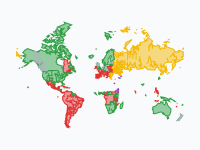
The map follows what Europe, and later the rest of the world, made of him. It starts with the saint's cult, shows the children's feast that grew out of it, and then the figures that replaced, copied or pushed aside the bishop: Luther's Christ Child, the Weihnachtsmann, Father Christmas, Santa Claus, Père Noël, the Nordic tomte and Grandfather Frost. Where two figures share a country, their outlines overlap.
From Myra to Bari: The Saint (343–1087)
Tradition has Nicholas born around 270 at Patara and remembers him for giving in secret. His cult spread first through the Greek East. Around 550 the emperor Justinian built a shrine of Saints Priscus and Nicholas in Constantinople, although that may have honoured a different, martyred Nicholas. By about 900 he was a patron saint across Byzantium and in the Greek south of Italy.
Two events carried him north. In 972 the Byzantine princess Theophanu married Otto II in Rome, and she probably helped to bring the cult into the Holy Roman Empire. In 988 the Rus' were baptised at Kyiv and took Nicholas as their favourite saint. The decisive step came on 9 May 1087, when sailors from Bari carried his relics off from Myra. Pope Urban II laid them in the crypt of a new basilica in 1089, Venice took the remaining bones in 1100, and in the 1090s a finger bone reached Lorraine, at what became Saint-Nicolas-de-Port. On the map this is the pale ochre wash that covers most of Europe by 1500.
A Feast for Schoolboys (1150–1500)
Nicholas was the patron of pupils, and the gifts began at school. From the 12th century the monastery and cathedral schools of northern France and the Rhineland kept his day as a feast for their boys, and the plays of the Fleury Playbook staged his legends: the three daughters who get their dowries and the three murdered scholars he brings back to life. From about 1300 a boy bishop ruled for a day. The feast reached the Low Countries by the 14th century. The accounts of Dordrecht note a school holiday on St Nicholas's Day in 1360, and in 1427 money was put in children's shoes at the Nicolaaskerk in Utrecht, the earliest Dutch record of the shoe.
This is the purple layer: Nicholas as a gift-bringer for children on 5 and 6 December. Around 1500 it reached from England to Bohemia and Silesia.
The Reformation Splits the Presents (1535–1800)
Protestants had no use for a saint who handed out rewards. Around 1535 Martin Luther promoted the 'Heiliger Christ' as the bringer of presents, which moved them from St Nicholas's Eve to Christmas. On 4 December 1570 the Protestant council of Strasbourg abolished the saint's feast and moved its fair to the Christ Child: the Christkindelsmärik. On the map the yellow Christkind takes the Lutheran north and east of Germany, while Nicholas keeps the Catholic Rhineland, the south and the Habsburg lands.
In England the feast disappeared, and a different figure took the stage. In Ben Jonson's 'Christmas, His Masque' of 1616, Old Christmas is a bearded spirit of feasting who brings no presents. The Dutch were the exception. Amsterdam turned Calvinist in 1578, and in 1663 the city banned the St Nicholas market. After protests by the young it gave in, and a few years later Jan Steen painted the feast in a Dutch living room. In the Eastern Alps the saint got company: Krampus, his horned companion, enters the record around 1600. No source names him before the end of the 16th century, which is why historians doubt the popular story of his pagan origin.
New York Makes Santa Claus (1675–1863)
The Dutch took the feast with them to the Hudson. In March 1675, eleven years after the English took New Amsterdam, a baker in Albany billed for 'suntterclaesgoet', Sinterklaas goods. It is the earliest known trace of the feast in Dutch New York, and for a century almost the only one. Santa Claus was not handed down by those settlers. He was made by New York writers who went looking for a Dutch past, as the historian Charles W. Jones argued in 1954. Washington Irving's Knickerbocker history of 1809 turned St Nicholas into the patron of Dutch New York, and on 6 December 1810 the New-York Historical Society dined in his honour and toasted 'Sancte Claus'.
In 1821 the poem 'Old Santeclaus' gave him a reindeer sleigh and Christmas Eve. On 23 December 1823 a newspaper in Troy printed 'A Visit from St. Nicholas', with eight reindeer, a chimney and a jolly old elf. From 3 January 1863 Thomas Nast drew him in Harper's Weekly, with the round belly, the workshop and, from 1866, an address at the North Pole. On the map the red layer starts as a dot on Manhattan in 1810 and covers the United States and English-speaking Canada by 1863.
Every Nation Its Own Old Man (1835–1937)
The 19th century gave almost every country a bearded man of its own. In Germany the word Weihnachtsmann was in print by 1770, and Hoffmann von Fallersleben's song 'Morgen kommt der Weihnachtsmann' of 1835 made him the gift-bringer of the Protestant north, while the Christkind drifted to the Catholic south and to Austria, Bohemia and Hungary. In France the name 'père Noël' was first printed in 1848. In the Netherlands, Jan Schenkman's picture book of 1850 fixed the modern Sinterklaas: the steamboat from Spain, the ride over the rooftops and the servant who was later named Zwarte Piet.
In Scandinavia the house gnome moved into Christmas. Danish painters drew the first julenisser from 1836, and in Sweden Jenny Nyström's pictures for Viktor Rydberg's poem 'Tomten' (1881) and her Christmas cards gave the tomte the presents that the Yule Goat used to bring. In England, Father Christmas merged with the American Santa from the 1850s and sailed with the Empire to Australia, New Zealand and South Africa. In Russia a fairy tale of 1840 turned the frost spirit into a kind but strict old man, and by the 1880s Ded Moroz brought children presents.
The Soviet Union first attacked him: in 1928 Ded Moroz was 'an ally of the priest and kulak'. Then it adopted him. A letter by Pavel Postyshev in Pravda on 28 December 1935 brought the tree back, and in January 1937 Ded Moroz greeted children at the House of Unions in Moscow with his granddaughter Snegurochka, at New Year and no longer at Christmas.
Frost, Coca-Cola and the Return of the Saint (1948–2026)
After 1948 Grandfather Frost was exported to the Soviet bloc. Romania replaced Moș Crăciun with Moș Gerilă, and Yugoslavia got Dedek Mraz and Deda Mraz. In Czechoslovakia the prime minister announced on the radio at Christmas 1952 that the Christ Child had grown a beard and was becoming Děda Mráz, but that campaign faded within years, as did Poland's, and Hungary merely renamed its Mikulás. After 1989 the old names came back. Since 2023 Ukraine keeps St Nicholas Day on 6 December, and Sviatyi Mykolai is pushing out the Soviet Did Moroz.
In the West, Santa went global. On 27 November 1924 he closed the first Macy's parade in New York, and from 1931 Haddon Sundblom's advertisements for Coca-Cola gave him one face worldwide (they did not invent the red suit). Not everyone was pleased. On 23 December 1951 clergy in Dijon burned Père Noël in effigy in front of some 250 children, as a pagan import. In the Basque Country the charcoal-burner Olentzero was revived in 1952 and became a gift-bringer in the 1970s, a home-grown answer to Papá Noel. In Spain the Three Kings still outrank him.
The Netherlands and Belgium are the part of the map where the saint himself still wins, at least with children. Santa fills the December advertisements, but the presents come from Sinterklaas on 5 December. Adults have tilted to Christmas: in a 2021 PwC survey 85% of the Dutch kept Christmas and 53% Sinterklaas, and they spent more on Christmas gifts (€153 against €116). About half of Dutch adults still celebrate Sinterklaas (52% in a 2025 survey by Panel Inzicht). The last twist is in Demre, the old Myra. In 2005 the town replaced a bronze statue of its bishop with a red-suited plastic Santa Claus. In Turkey he now comes as Noel Baba, with presents at New Year.
How to Read the Map
Each colour is a figure. The pale ochre wash is the cult of the saint; it is switched off after 1535 to keep the map readable, although the veneration went on. Purple is Nicholas as a gift-bringer on 5 and 6 December (Sinterklaas, Nikolaus, Mikuláš, Mikołaj, Mikulás). Yellow is the Christkind, orange the Weihnachtsmann and his namesakes, green Father Christmas, red Santa Claus, pink Père Noël and his kin (Babbo Natale, Papá Noel, Pai Natal, Moș Crăciun), teal the Nordic tomte and nisse, blue Ded Moroz, with a lighter blue for the Frost figures west of Russia. Indigo is Saint Basil in Greece, slate is Olentzero, and the dark red outline is Krampus country.
Overlapping outlines are figures that share a country, such as Nikolaus on 6 December and the Christkind on the 24th. In the Low Countries the Kerstman and Père Noël are a faint red wash under Sinterklaas: present, but second. The borders are those of modern countries and regions, with Germany split by federal state, and they show roughly where a figure was the usual gift-bringer. Medieval extents, the Protestant and Catholic halves of Germany, Africa and the edge of Santa's reach in Asia are approximate, and dates before 1800 are indicative. Gift-bringers outside Nicholas's family are not on the map: the Three Kings, the Befana, St Lucy, St Martin, and the Christ Child who still brings the presents in Colombia, Bolivia and Costa Rica.
How the Map Was Made
The map has 16 layers, 31 dated steps and 65 markers. Every area is built from Natural Earth countries and regions, so that neighbouring figures share exactly the same border. The story was laid out so that each step changes one part of the world, which lets the camera stay on Europe for the European chapters and move out for Santa's.
All dates and claims were checked against Wikipedia in seven languages and against sources such as the St. Nicholas Center, Procopius's Buildings, the Rijksmuseum, the 1850 text of Schenkman's book in the DBNL and the PwC survey of 2021. Several stories that are often told did not survive that check. The French nuns who are said to have started the gifts around 1150 have no medieval source. Luther did not invent the Christkind. It was not burgomaster Tulp who banned the feast in Amsterdam in 1663 (he was not in office, and the ban was on the market). Schenkman's horse has no colour in the first edition. And the liveliest claim of all, that Santa is a Dutch custom that survived in New York, is doubted by historians.
Chronological Timeline
- 6 December 343 — Nicholas, bishop of Myra, dies (traditional date)
- c. 550 — Justinian builds a shrine of Sts Priscus and Nicholas in Constantinople
- 972 — Theophanu marries Otto II in Rome
- 988 — The Rus' are baptised at Kyiv
- 9 May 1087 — Sailors bring the relics from Myra to Bari
- 12th century — School feasts and Nicholas plays in northern France and the Rhineland
- 1360 — Dordrecht: oldest Dutch record of the feast
- 1427 — Utrecht: money in children's shoes
- c. 1535 — Luther promotes the 'Holy Christ' as bringer of presents
- 4 December 1570 — Strasbourg replaces its St Nicholas market with the Christkindelsmärik
- c. 1600 — Krampus enters the record in the Eastern Alps
- 1616 — Ben Jonson puts Old Christmas on stage in London
- 1663 — Amsterdam bans the St Nicholas market and gives in
- March 1675 — 'Sinterklaas goods' billed in Albany
- 1809–1810 — Irving's Knickerbocker; New York toasts 'Sancte Claus'
- 23 December 1823 — 'A Visit from St. Nicholas' is printed in Troy
- 1835 — 'Morgen kommt der Weihnachtsmann'
- 1848 — 'Père Noël' first in print
- 1850 — Schenkman's 'Sint Nikolaas en zijn knecht'
- 3 January 1863 — Thomas Nast's first Santa in Harper's Weekly
- 1881 — Jenny Nyström illustrates Rydberg's 'Tomten'
- 27 November 1924 — Santa closes Macy's first parade
- 1928 — Ded Moroz is attacked as 'an ally of the priest and kulak'
- 1931 — Haddon Sundblom's first Coca-Cola Santa
- January 1937 — Ded Moroz and Snegurochka at the House of Unions
- 1948 — Moș Gerilă replaces Moș Crăciun in Romania
- 23 December 1951 — Père Noël is burned in effigy in Dijon
- 1952 — Olentzero is revived in Zarautz
- 24 December 1955 — US air defence starts 'tracking' Santa
- 5 December 1957 — 'Black Sinterklaas' in Indonesia
- 1989–1991 — The Soviet bloc dissolves; Moș Crăciun and others return
- 2005 — Demre swaps its statue of the saint for a Santa
- 12 November 2011 — 'Zwarte Piet is racisme' protest at Dordrecht
- 2023 — Ukraine moves St Nicholas Day to 6 December
Watch the saint's cult spread and split into Sinterklaas, the Christkind, Santa Claus and Grandfather Frost in the interactive map, click the pins for the stories behind each step, or embed the map on your own site.
Explore the full interactive map →Frequently asked questions
- Is Santa Claus the same as Sinterklaas?
- Santa Claus descends from Sinterklaas, the Dutch name for Saint Nicholas, but he is a separate figure. He was made in New York between 1809 and 1823 by writers who revived the Dutch saint: Washington Irving's Knickerbocker history (1809), the New-York Historical Society's St Nicholas dinner of 6 December 1810, the poem 'Old Santeclaus' (1821) and 'A Visit from St. Nicholas' (1823). Historians such as Charles W. Jones see him as their invention and not as a Dutch folk custom that survived. Sinterklaas still comes to the Netherlands and Belgium on 5 and 6 December, as a bishop.
- Who was the real Saint Nicholas?
- Nicholas was a Greek bishop of Myra in Lycia, on the south coast of what is now Turkey. Tradition says he was born around 270 at Patara and died on 6 December 343, and he was remembered for giving in secret. In 1087 sailors from Bari carried his relics to Italy, which spread his cult across Latin Europe.
- Why does the Christkind bring the presents in parts of Germany and Austria?
- Around 1535 Martin Luther promoted the 'Heiliger Christ' as the bringer of presents at Christmas, in place of Saint Nicholas on 6 December. The Christ Child first took the Protestant north of Germany. In the 19th and 20th centuries it drifted to the Catholic south and to Austria, Bohemia and Hungary, while the Weihnachtsmann took its place in the north. Luther did not invent the Christkind: he promoted a figure that already existed.
- Where does Father Christmas come from?
- Father Christmas is English and older than Santa Claus. In Ben Jonson's 'Christmas, His Masque' of 1616 he is a bearded spirit of feasting who brings no presents. He started to bring them only when he merged with the American Santa Claus, from the 1850s; by the 1880s the two were used as one figure.
- Who is Ded Moroz, and why does he come at New Year?
- Ded Moroz, Grandfather Frost, grew out of a Russian frost spirit. An 1840 fairy tale by Odoevsky made him a kind but strict old man, and by the 1880s he brought children presents. The Soviet Union attacked him in 1928 as 'an ally of the priest and kulak', then brought him back with the New Year tree after a letter in Pravda on 28 December 1935. Since then he comes at New Year, not at Christmas, and after 1948 similar figures were introduced in the Soviet bloc.
- Do the Dutch still prefer Sinterklaas to Santa Claus?
- For children, yes: their presents come from Sinterklaas on 5 December. Adults have tilted to Christmas. In a 2021 PwC survey 85% of the Dutch kept Christmas and 53% Sinterklaas, and they spent more on Christmas gifts (€153 against €116). About half of Dutch adults celebrate Sinterklaas (52% in a 2025 Panel Inzicht survey).
- Is there an animated map of the history of Santa Claus and Sinterklaas?
- Yes. Moving Polygons has a free animated map that follows Saint Nicholas and the gift-bringers that came after him from 343 to 2026, in 31 steps: the saint's cult, Sinterklaas and Nikolaus, the Christkind, the Weihnachtsmann, Father Christmas, Santa Claus, Père Noël, the Nordic tomte, Ded Moroz and Krampus. You can watch it and embed it on your own website.
Text version of the map (timeline, layers and events): Markdown