From Britain to Alaska on Foot
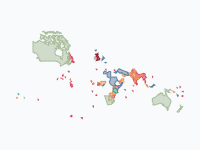
Fifteen thousand years ago you could have walked from Britain to Alaska on dry land and met woolly mammoths for most of the way. Today the whole elephant family, living and extinct, is down to a scatter of patches in Africa and southern Asia, and this map follows that shrinking range frame by frame, from the peak of the last Ice Age to the most recent IUCN range maps.
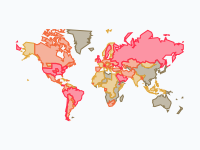
Seven colours mark the species: the woolly mammoth in orange, the Columbian mammoth in red and its dwarf island relative, the pygmy mammoth, in yellow; the African savanna elephant in blue, the African forest elephant in purple, the extinct North African elephant in pink and the Asian elephant in green. White is ice, and a sand colour marks land that was dry when the sea stood about 120 m lower and is sea now.
The Mammoth Steppe
The woolly mammoth was an animal of cold, dry grassland, the mammoth steppe, and its range followed that grassland rather than the cold itself. That explains a twist that surprises most people: at the very peak of the Ice Age, about 21,000 years ago, mammoths had all but left Europe. Dated bones show that they disappeared from the North European Plain between about 21,400 and 19,200 years ago and held on in the Central Russian Plain and in northern Siberia (Lister and Stuart, 2008; Nadachowski and colleagues, 2018). The maps that show mammoths from Spain to China all at once show the earlier, cumulative maximum, before the coldest millennia.
After about 19,000 years ago they came back, and the 15,000-years-ago frame shows the range at its widest: across Britain (the mammoths of Condover in Shropshire date from about 14,700 years ago) and Doggerland, the plain that is now the floor of the North Sea, through central Europe, the Russian Plain and southern Siberia to Beringia, the land bridge where the Bering Strait is today. On the map that is about 26 million km², more than twice the area of the United States. In North America woolly mammoths also lived south of the ice sheet, from the Dakotas through the Great Lakes region to the Atlantic shelf, where fishing boats have dredged up their teeth. There they shared the land with the Columbian mammoth, which ranged from the ice front to Mexico and Central America, and many animals of the Great Lakes region were hybrids of the two. Off California, mammoths that had swum to the island of Santarosae became pygmy mammoths about 1.7 m tall.
Ten Thousand Years of Retreat
As the climate warmed, forest and wet tundra spread over the grassland and the mammoth's range fell apart. They were gone from most of Europe by about 14,000 years ago and from south of the North American ice about 13,000 years ago; the Columbian mammoth, with sites such as Dent in Colorado among the youngest, and the pygmy mammoth were gone by about 12,700 years ago. In the 13,000 and 11,500 frames the woolly mammoth holds only the Arctic coast of Siberia and the far north-east of Europe, and its youngest mainland bones, from the Taimyr, Yamal and Gydan peninsulas, are about 11,000 years old.
Then the sea finished the job. Rising water cut off St Paul Island in the Bering Sea, where a small population lasted until about 5,600 years ago and probably died when its fresh water ran short, and Wrangel Island in the Arctic Ocean, where the last mammoths lived until about 4,000 years ago. On the map the range goes from about 26 million km² 15,000 years ago to two islands of together less than 8,000 km² 6,000 years ago. Hunting by people added pressure on the shrinking herds; how much it counted next to the change in climate is still argued over.
Elephants in Syria, the Sahara and on the Yellow River
Elephants did better in the warm millennia after the Ice Age, and their range reached places that seem unlikely today. In the 9,000-years-ago frame the Sahara is green and elephants live across it, as the rock engravings of the Tassili n'Ajjer and the Messak show; as the desert returned they withdrew south, and Egypt had lost its wild elephants by about 3600 BC, or by 3100 BC at the latest. In the Maghreb a population survived north of the desert. Carthage used these North African elephants in war (Hannibal crossed the Alps with 37 in 218 BC), Roman games and hunting finished them, and in AD 370 the orator Themistius wrote that elephants had been removed from Libya.
Asian elephants appear in the Orontes valley and along the Euphrates in Syria and south-east Turkey from about 1800 BC. Pharaoh Thutmose III hunted 120 of them near Niy around 1450 BC, Assyrian kings hunted them until the 9th century BC, and by about 700 BC they were gone; whether they were native or brought in by Bronze Age rulers is still debated. In China, elephant bones and oracle-bone inscriptions show elephants near Anyang on the Yellow River about 3,000 years ago (whether wild or kept by the Shang kings is debated). Over the next three millennia, as farmland spread and forests were cut, the northern limit crept south: to the Huai river, south of the Yangtze by about AD 1000, to the far south of Guangdong and Guangxi, and finally to southern Yunnan. About 300 wild elephants live there today, and in 2020–2021 a herd of 15 walked some 500 km north to the outskirts of Kunming.
Two Centuries of Collapse
Around 1800 African elephants still lived almost everywhere south of the Sahara, from the Sahel to the Cape. The ivory trade of the nineteenth century emptied South Africa first: the last elephant near Cape Town was shot in 1704, and by 1900 only a few pockets were left, at Addo, in the Knysna forests, in the lowveld and at Tembe. Addo Elephant National Park was founded in 1931 to protect the last 11 elephants of the Eastern Cape; it now holds more than 600. In 1979 Iain Douglas-Hamilton's survey estimated 1.34 million African elephants over 7.3 million km². The poaching of the 1980s cut that to about 600,000 by 1989, when the ivory trade was banned. The African Elephant Status Report of 2016 counted about 415,000 elephants in 3.1 million km², and a 2021 study found that elephants now use about 17% of the African land that could support them. In 2021 the IUCN split the species in two: the savanna elephant is endangered and the forest elephant critically endangered.
In Asia the losses are older and less visible. A 2023 study by de Silva and colleagues modelled the habitat of the Asian elephant since 850 and found that 64% of it was lost after 1700, as colonial-era farming and logging spread; in China the loss is 94%. Central India, where the Mughal emperors caught wild elephants, was empty by the 1920s, and Sri Lanka's hill country was cleared for coffee plantations in the 19th century. The IUCN puts the wild population at about 48,000 to 52,000, and the current range is perhaps a tenth to a seventh of the historical one. There is one hopeful line on the map: since 2017 herds have walked back into central India, to Sanjay-Dubri and Bandhavgarh, for the first time in about a century.
How to Read the Map
Each colour is one species; where two ranges overlap, the colours mix. The captions give the real age of each frame. The map's database cannot store dates earlier than 4713 BC, so the five Ice Age frames (21,000 to 9,000 years ago) sit at 4700 to 4300 BC on the time slider; from 4050 BC (6,000 years ago) on the slider dates are real. The sand-coloured land appears in the Ice Age frames and is gone by 6,000 years ago, when the sea had nearly reached its present level. The ice sheets shrink back to Greenland and the Arctic islands, which keep theirs. White pins and dots mark the finds and events behind the frames.
Ranges are drawn at continental scale. Prehistoric ranges rest on scattered dated fossils, so their edges are informed estimates, not lines anyone surveyed; the tip of the Columbian mammoth's range in Costa Rica, for instance, rests on a single undated tooth. Whether wild elephants lived on Java in historical times is disputed. In Africa the frames for 1900 and 1950 are interpolations between the range of 1800 and the surveys from 1979 on (only South Africa's last pockets in 1900 are documented), because no continent-wide count exists before then.
How the Map Was Made
Coastlines and ice sheets of the Ice Age frames come from the ICE-6G_C reconstruction of Peltier, Argus and Drummond (2015), combined with today's coasts from Natural Earth; the shores of Santarosae and St Paul Island come from GMRT bathymetry at the sea level of each frame. The mammoth ranges follow the dated fossils summarised by Lister and Stuart (2008), Stuart and colleagues (2004), Nadachowski and colleagues (2018) and, south of the North American ice, Widga and colleagues (2017) and Enk and colleagues (2016), with Graham and colleagues (2016) for St Paul and Vartanyan and colleagues for Wrangel. The Syrian elephants follow Çakırlar and Ikram (2016), China follows Wen Huanran and Mark Elvin's The Retreat of the Elephants (2004), and Asia since 1800 follows the habitat maps of de Silva and colleagues (2023).
Today's ranges are generalised from the IUCN Red List maps (Asian elephant 2020, African savanna and forest elephants 2021), with the central-Indian herds that returned after 2017 added. The 1980 frame is the African Elephant Database range of 2007 widened to the 7.3 million km² estimated for 1979. Elephants inside the rainforest belt are drawn as forest elephants and the rest as savanna elephants; the IUCN itself counts most West African herds, also those in savanna parks, as forest elephants.
Chronological Timeline
- About 21,000 years ago — Peak of the last Ice Age; woolly mammoths hold on in the Russian Plain, northern Siberia and Beringia
- About 15,000 years ago — Woolly mammoths range from Britain to Alaska and south of the North American ice to the Atlantic
- About 13,000–12,700 years ago — Last woolly mammoths south of the North American ice; Columbian and pygmy mammoths die out
- About 9,000 years ago — Green Sahara: elephants across North Africa
- About 5,600 years ago — Last mammoths of St Paul Island
- About 3600 BC — Wild elephants gone from Egypt
- About 4,000 years ago — Last mammoths of Wrangel Island
- 8th century BC — Syrian elephants extinct
- 218 BC — Hannibal crosses the Alps with 37 North African elephants
- AD 370 — Themistius: elephants have been removed from Libya
- 1931 — Addo Elephant National Park founded for the last 11 elephants of the Eastern Cape
- 1979 — About 1.34 million African elephants over 7.3 million km²
- 1990 — International ivory trade ban
- 2016 — About 415,000 African elephants in 3.1 million km²
- 2021 — IUCN lists the African savanna elephant as endangered and the forest elephant as critically endangered
Watch the ranges shrink from the Ice Age to today, click the pins for the last mammoths and the lost elephants of Syria and North Africa, or embed the map on your own site.
Explore the full interactive map →Frequently asked questions
- Where did woolly mammoths live?
- On the cold, dry grassland called the mammoth steppe. About 15,000 years ago, after the coldest part of the last Ice Age, woolly mammoths lived from Britain and the dry floor of the North Sea across central and eastern Europe and Siberia to Alaska and the Yukon, and south of the North American ice sheet from the northern Great Plains through the Great Lakes region to the Atlantic shelf. At the peak of the Ice Age, about 21,000 years ago, they had pulled back from most of Europe and held on in the Central Russian Plain, northern Siberia and Beringia.
- When did the last mammoths die out?
- Woolly mammoths disappeared from most of Europe by about 14,000 years ago and from south of the North American ice sheet about 13,000 years ago; the youngest bones on the Eurasian mainland are about 11,000 years old, from the Taimyr, Yamal and Gydan peninsulas. Two island populations lasted much longer: St Paul Island in the Bering Sea until about 5,600 years ago, and Wrangel Island in the Arctic Ocean until about 4,000 years ago, centuries after the Great Pyramid was built. Columbian mammoths and the pygmy mammoths of the Channel Islands were gone by about 12,700 years ago.
- Why did the mammoths go extinct?
- As the climate warmed after the Ice Age, forest and wet tundra replaced the cold, dry grassland the mammoths fed on, and their range broke up and shrank. Human hunters added pressure on the shrinking populations. How much each cause counted is still debated. On St Paul Island, where no people lived, the last mammoths probably died when fresh water ran short as the sea rose.
- How much of their range have elephants lost?
- In Africa, elephants lived almost everywhere south of the Sahara around 1800. In 1979 their range was estimated at 7.3 million km², and the African Elephant Status Report of 2016 put it at 3.1 million km²; a 2021 study found that elephants use about 17% of the African land that could support them. Asian elephants once lived from the Euphrates and the Yellow River to Sumatra; their current range is perhaps a tenth to a seventh of that, and a 2023 study found that 64% of their suitable habitat has been lost since 1700.
- How many elephants are left in the wild?
- The last continent-wide count of African elephants, from 2016, gave about 415,000 (savanna and forest elephants together). Forest elephants alone were estimated at about 135,700 in a report released in 2025. For Asian elephants the IUCN gives about 48,000 to 52,000; India, which holds almost half of them, counted 22,446 in 2025 with a new DNA-based method that cannot be compared with older counts. In 1979 there were about 1.3 million elephants in Africa.
- Were there ever wild elephants in the Middle East, North Africa or northern China?
- Yes. Asian elephants lived in the Orontes valley and along the Euphrates in Syria and south-east Turkey from about 1800 BC; Pharaoh Thutmose III hunted them there around 1450 BC, and they were gone by the 8th century BC. North African elephants lived in the Atlas Mountains and the hills of Morocco, Algeria and Tunisia, carried Carthage's armies, and were extinct by the 4th century AD. In China, elephants lived near Anyang on the Yellow River about 3,000 years ago and then retreated south over three millennia to southern Yunnan, where about 300 remain.
- Is there an animated map of where elephants and mammoths lived?
- Yes. Moving Polygons has a free animated world map of the ranges of woolly, Columbian and pygmy mammoths and of African savanna, African forest, North African and Asian elephants, from 21,000 years ago to today, in 19 frames with the Ice Age ice sheets and the land that was dry when the sea was lower. You can watch it, click its pins and embed it on your own website.
Text version of the map (timeline, layers and events): Markdown